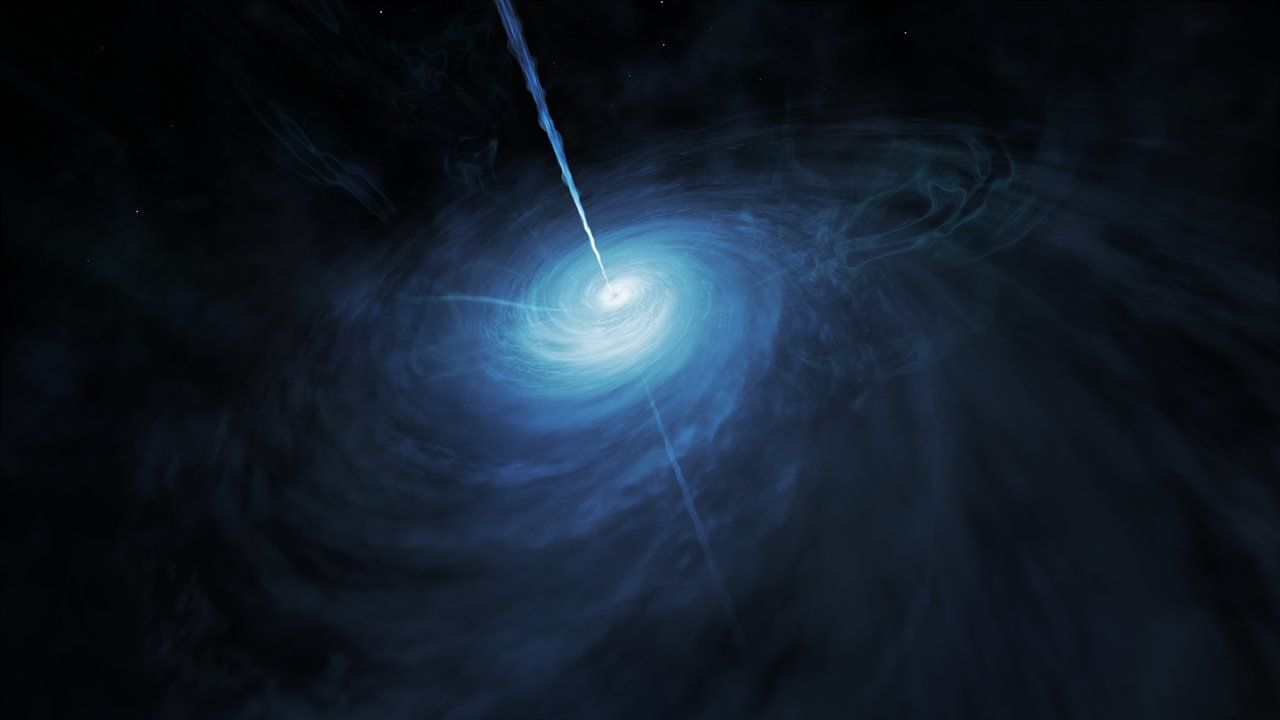
Astronomers have identified a record-breaking ancient quasar that existed 12.9 billion years ago, offering new clues about how supermassive black holes formed and grew in the early universe.
The discovery reveals that supermassive black holes aged far more rapidly than previously thought possible during the universe's infancy. This finding challenges existing models of black hole formation and growth.
Quasars are among the brightest objects in the universe, powered by supermassive black holes at their centers. When astronomers detect quasars from the early universe, they gain direct evidence of black holes that existed when the cosmos was extremely young. The existence of massive black holes just 900 million years after the Big Bang has puzzled scientists for years, since traditional formation mechanisms predict they should take much longer to develop.
This newly identified quasar demonstrates that the rapid growth timescale researchers previously proposed may actually occur in nature. The finding suggests that supermassive black holes can accumulate mass far faster than standard accretion models predict, or that alternative formation pathways exist beyond conventional understanding.
The observations support recent theoretical work proposing mechanisms like boosted accretion rates, mergers between intermediate-mass black holes, or other exotic pathways that could explain how supermassive black holes reached billion-solar-mass scales so quickly after the Big Bang.
Understanding black hole formation in the early universe remains one of astronomy's most pressing questions. Each newly discovered ancient quasar provides a data point that constrains formation models and pushes astronomers to refine their understanding of how the cosmos evolved. This record-breaking quasar adds crucial observational evidence to that growing catalog, though researchers acknowledge that many questions remain about the specific mechanisms driving rapid black hole growth in the universe's first billion years.