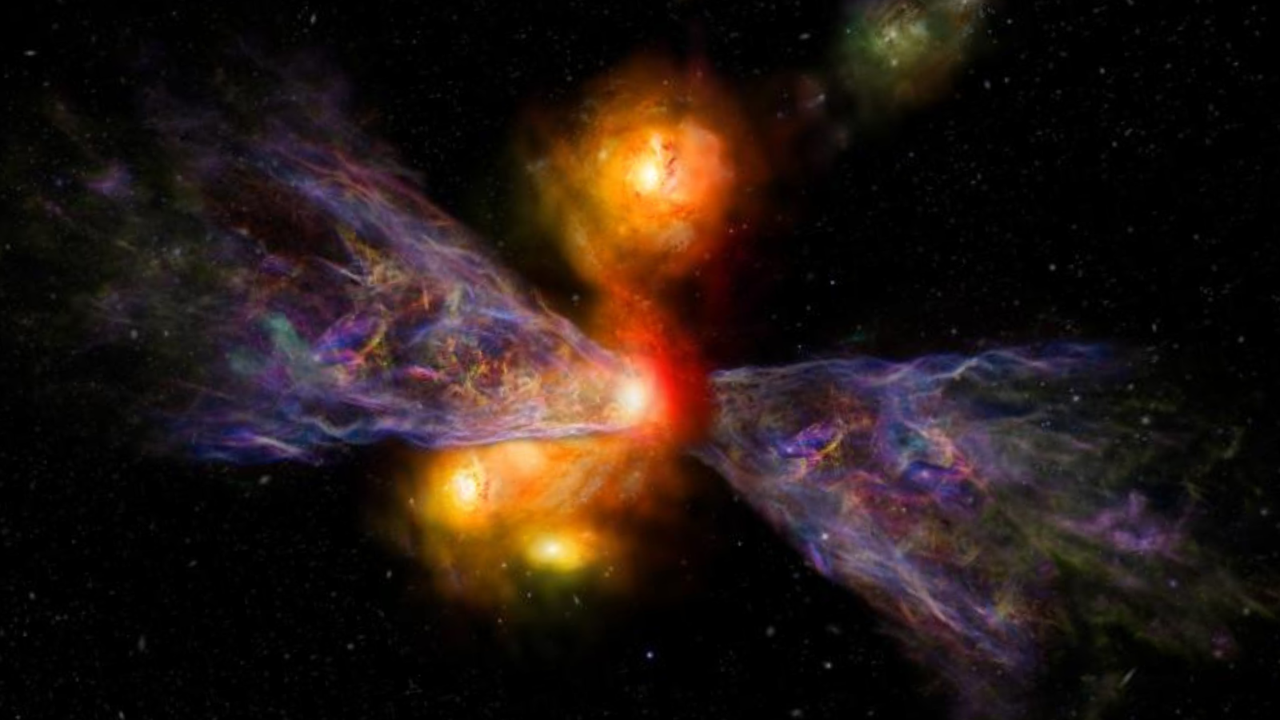
The James Webb Space Telescope has detected powerful galactic winds that may explain why massive galaxies in the early universe halted star formation earlier than astronomers anticipated. These winds, driven by cosmic mergers, appear to strip gas from galaxies and shut down their star-producing engines.
Researchers used JWST and the Atacama Large Millimeter/submillimeter Array (ALMA) to observe these phenomena in distant galaxies. The data reveals that when galaxies collide and merge, the resulting gravitational upheaval triggers intense outflows of gas traveling at extreme speeds. These "galaxy-killing" winds expel the cold gas necessary for ongoing star formation, effectively terminating a galaxy's reproductive capacity.
The discovery addresses a longstanding puzzle in cosmology. Simulations predicted that massive galaxies should continue forming stars for billions of years, yet observations show many ancient galaxies became quiescent far sooner. The new evidence suggests mergers and their associated superwinds provide the mechanism responsible.
The cosmic mergers generate energy that heats and accelerates gas outward. Once expelled, this gas cannot recondense to form new stars. A single merger event can therefore transform an actively star-forming system into a dead galaxy in a relatively short timeframe. The early universe contains numerous such merger events, explaining why astronomers observe so many massive but inactive galaxies at high redshifts.
This work combines JWST's infrared sensitivity with ALMA's millimeter wavelength observations to trace both the stellar and gaseous components of these violent events. The complementary capabilities of both observatories reveal the full scope of galactic transformation occurring in the universe's first few billion years.
The findings carry implications for galaxy evolution models. Astronomers must now account for these rapid quenching mechanisms when predicting how galaxies develop over cosmic time. Future observations will determine how common these superwind events are and