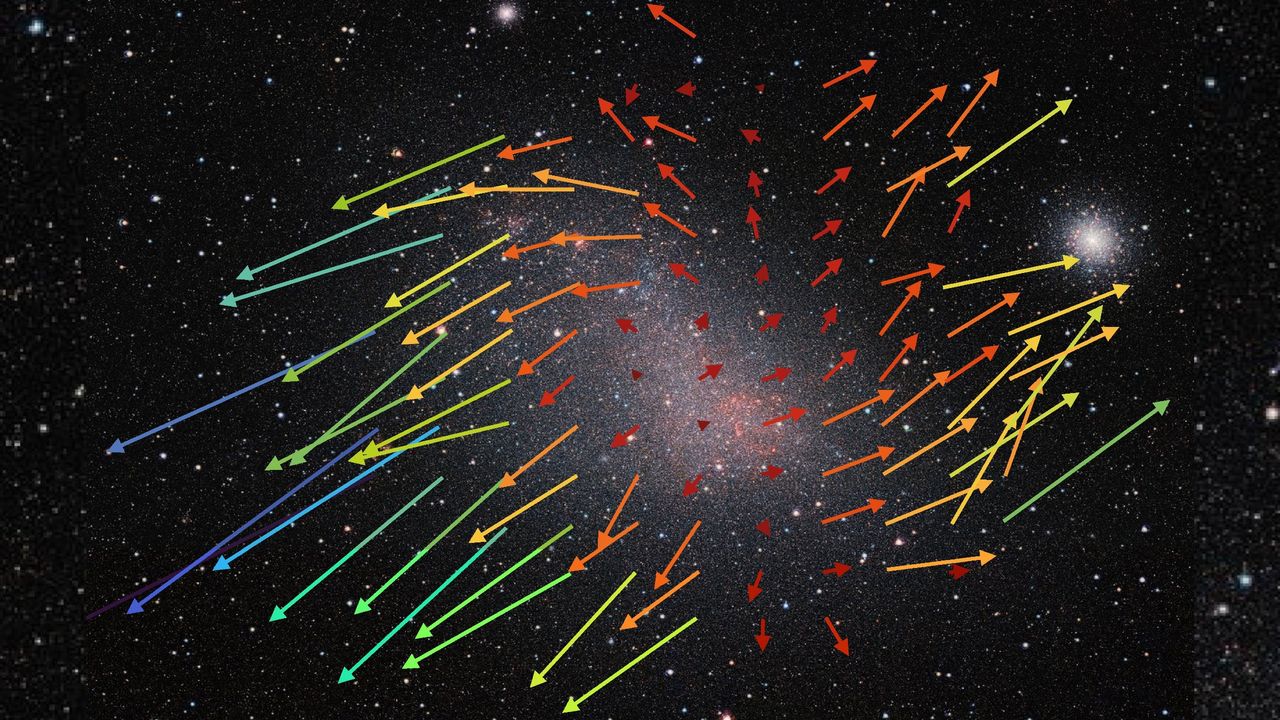
Astronomers have discovered that the Small Magellanic Cloud (SMC), a dwarf galaxy orbiting the Milky Way, is being systematically torn apart by gravitational forces from our galaxy. New research challenges previous assumptions about the stability and structure of this cosmic neighbor.
The SMC sits roughly 160,000 light-years from Earth on the outskirts of the Milky Way. For decades, scientists treated it as a relatively intact satellite galaxy. High-resolution observations and sophisticated gravitational modeling now reveal a more violent reality: the Milky Way's immense gravitational pull is actively stripping material from the SMC and stretching it across space.
This discovery emerged from detailed analysis of stellar streams and gas distributions surrounding the dwarf galaxy. Researchers identified evidence that the SMC's structure has been severely disrupted over millions of years. Tidal forces from the Milky Way's gravity well have elongated the SMC and pulled away significant quantities of stars and gas. Some of this material now forms visible tidal tails extending billions of miles into space.
The research reshapes our understanding of how galaxies interact. The SMC's disruption demonstrates that large galaxies actively reshape their satellite companions through gravitational interactions. This process, called tidal disruption, plays a crucial role in galactic evolution. Smaller galaxies lose material to their larger hosts, while larger galaxies grow by accumulating this stripped material.
The findings carry broader implications for understanding the Milky Way's own history. Our galaxy has likely consumed dozens of smaller satellites throughout its 13.8-billion-year existence. Each merger or disruption event has left traces in the current structure of stars and gas we observe today. The SMC provides a real-time laboratory for studying these processes.
Future observations using next-generation telescopes will refine the timeline of the SMC's destruction. Researchers aim