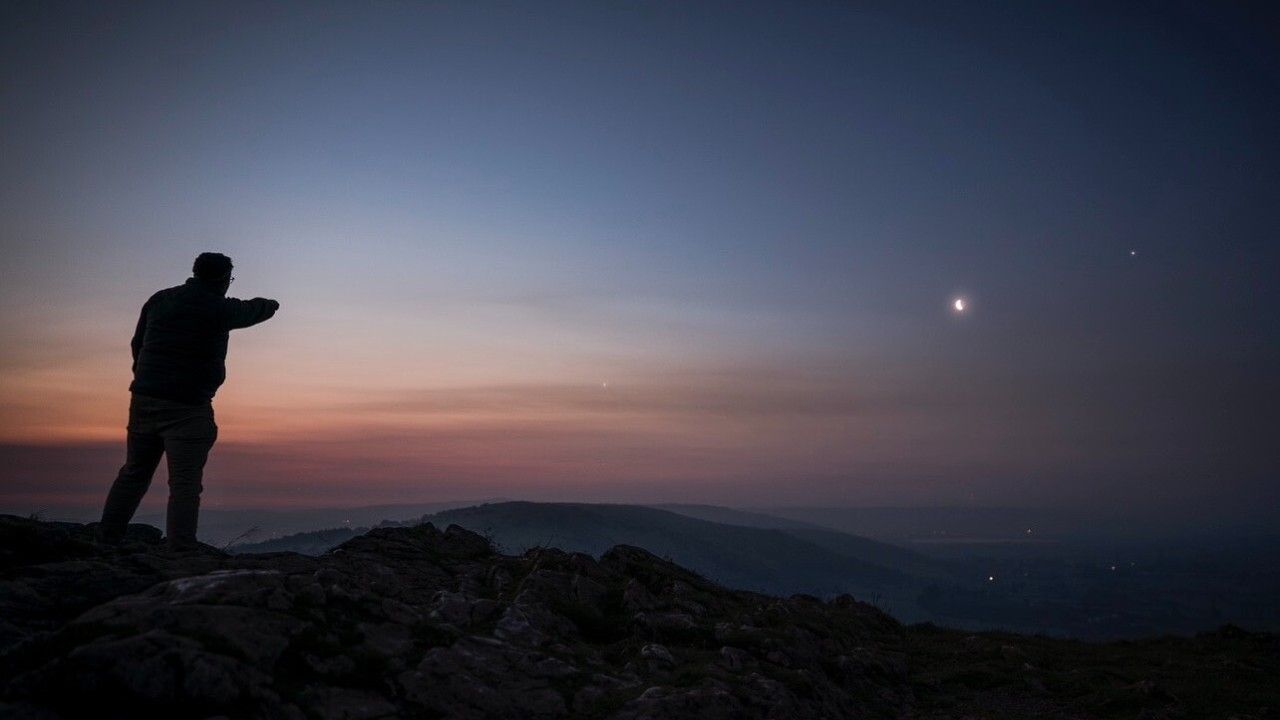
Three planets will align in a rare celestial arrangement on June 12, creating a striking visual display for skywatchers. Mercury, Venus, and Jupiter will line up low above the western horizon shortly after sunset, forming what astronomers call a planetary parade.
The event offers a brief window for observation. The three planets will cluster together in the sky, with their proximity to each other making them appear as a concentrated group rather than scattered across the heavens. This type of alignment happens when planets reach similar positions along their orbital paths as seen from Earth, though the exact configuration depends on each planet's position in its orbit around the sun.
Venus remains the brightest object in the night sky apart from the moon, making it relatively easy to locate. Jupiter ranks second among planets in brightness. Mercury presents more of a challenge for observers because it stays close to the sun and appears only briefly during twilight hours, either just before dawn or shortly after dusk.
The parade's timing matters. The three planets will be visible only for a limited period after sunset before dipping below the horizon. The lower the planets sit in the sky, the less time observers have to catch the view before atmospheric haze and the curvature of Earth obstruct them. Clear skies and an unobstructed western horizon enhance the viewing experience.
Planetary parades occur occasionally but not frequently. These alignments hold no gravitational significance and pose no threat to Earth. The planets maintain their normal orbital distances from each other. Their apparent closeness results entirely from the angle at which we view them from our perspective on Earth.
For those interested in observing, binoculars or small telescopes can enhance details of each planet's appearance. Venus will show a crescent phase through optical equipment, Jupiter may reveal cloud bands and its largest moons, and Mercury will appear as a small, bright disk. Even without optical aid, simply locating the three planets together offers a