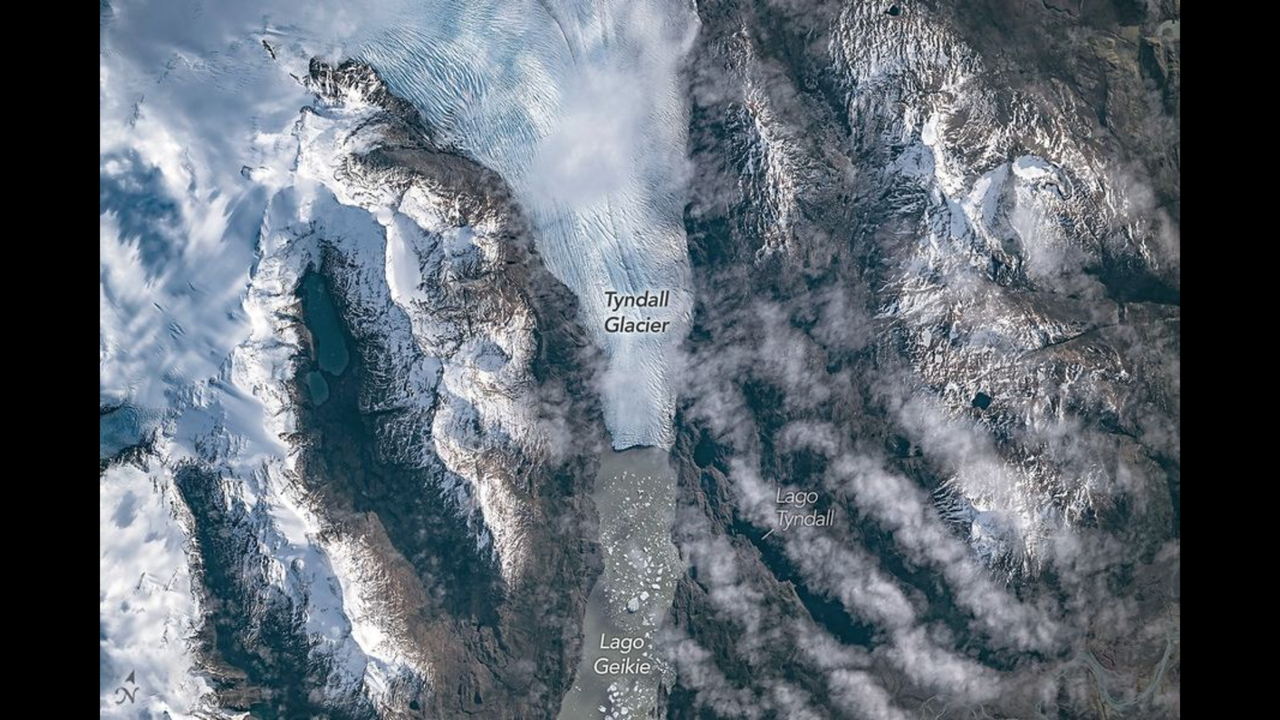
Astronauts aboard the International Space Station captured images of massive ice calving events at the Southern Patagonia Icefield, providing a striking visual record of glacial collapse from orbit.
The photographs document the fracturing and detachment of ice from one of South America's largest glacier systems, located in southwestern Argentina and Chile. Astronauts observed the dynamic process as it unfolded, capturing the precise moment when ice segments separated from the main glacier body, a phenomenon driven by accelerating glacier retreat linked to climate warming.
The Southern Patagonia Icefield spans roughly 13,000 square kilometers and feeds several outlet glaciers, including the frequently photographed Perito Moreno Glacier. These glaciers have experienced significant retreat over recent decades, with satellite data showing accelerating mass loss. The calving events visible from the space station represent the glacier's response to warming temperatures and changing precipitation patterns across Patagonia.
Space-based observations offer advantages over ground-level monitoring. Astronauts can document broad-scale changes, track seasonal variations, and capture ice dynamics that occur at speeds visible over hours or days. The photographs provide context that complements scientific instruments aboard Earth-observation satellites, which measure glacier elevation changes and surface velocity with precision.
These images underscore the power of human spaceflight for environmental monitoring. While automated satellites generate quantitative data essential for climate science, astronaut photography offers immediacy and clarity that engages public attention. The ISS orbits at 51.6 degrees inclination, positioning it to regularly observe Patagonian glaciers during passes over South America.
The visual documentation contributes to ongoing research into cryospheric change. Scientists use multiple data streams including satellite altimetry, synthetic aperture radar, and direct ground measurements to assess glacier health. The astronaut observations serve as qualitative validation of these datasets and demonstrate how rapidly alpine glaciers respond