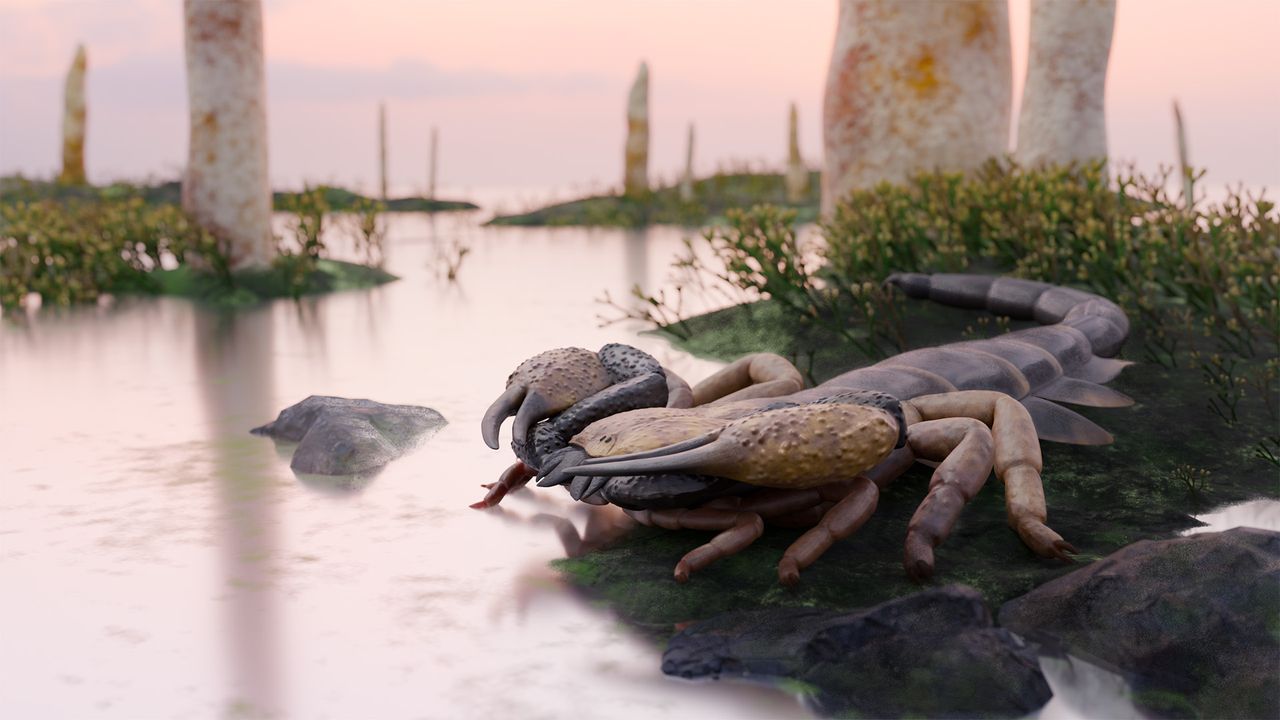
Paleontologists have identified fossils belonging to a giant scorpion that roamed the United Kingdom 415 million years ago during the Silurian period. The creature reached lengths of approximately 1 meter (3 feet), making it the world's largest known scorpion. Its pincers measured around 6 inches, according to researchers analyzing the specimens.
This discovery proves remarkable because terrestrial life during the Silurian was predominantly small. The giant scorpion represents an exception to this pattern, showcasing how some early land colonizers achieved extraordinary size. The fossils provide direct evidence that scorpions inhabited both aquatic and terrestrial environments far earlier than previously documented.
The Silurian period, spanning from roughly 444 to 419 million years ago, marked a critical transition when arthropods and other organisms first established themselves on land. Before this epoch, life remained confined almost entirely to oceans. Scorpions, being among the earliest arachnids to venture onto land, played a role in pioneering terrestrial ecosystems.
The 1-meter length of these ancient scorpions dwarfs modern species. The largest living scorpion, the emperor scorpion from West Africa, typically reaches only 20 centimeters (8 inches). The size disparity raises questions about environmental conditions in the Silurian. Higher oxygen levels in the ancient atmosphere may have permitted larger arthropods to thrive. Modern insects and arachnids face metabolic constraints imposed by current atmospheric composition, limiting how large they can grow.
Researchers examining the UK fossils identified key morphological features placing them squarely within Scorpiones, the arachnid order containing all scorpions. The prominent pincers and segmented tail structure matched characteristic scorpion anatomy, though some aspects of early scorpion evolution remain poorly understood.