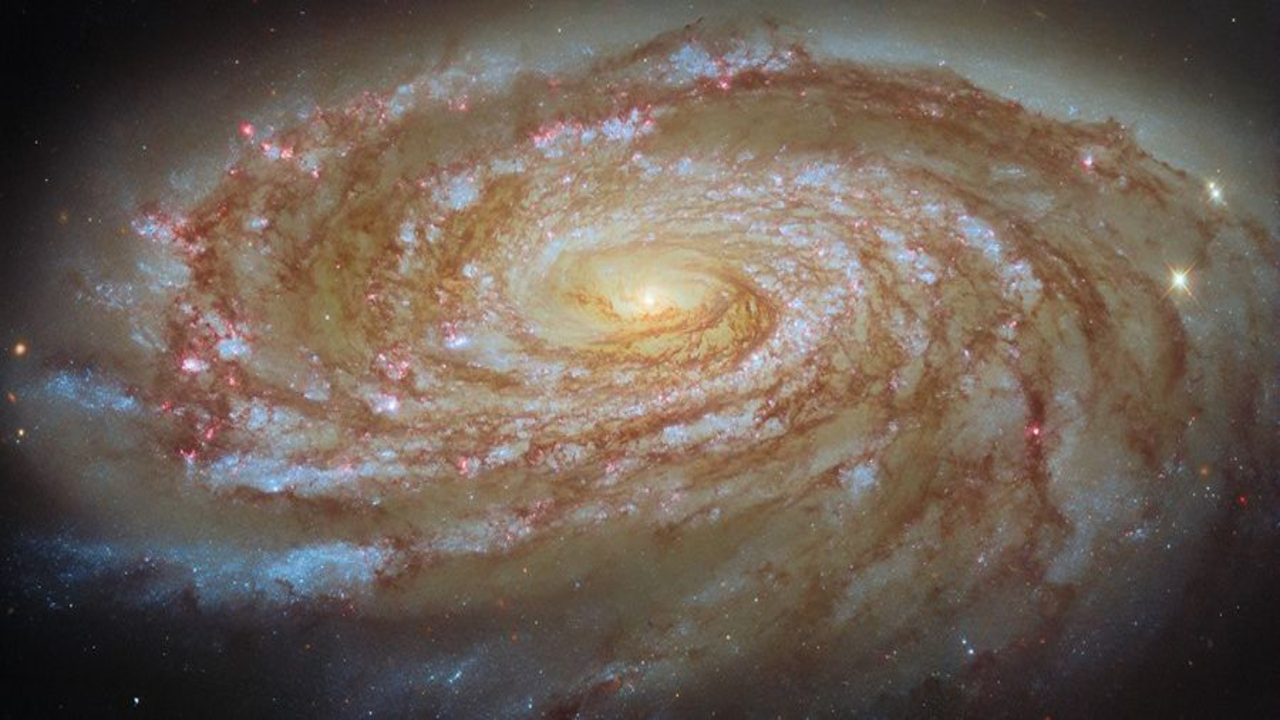
The Hubble Space Telescope captured a striking new image of Messier 88, a spiral galaxy also catalogued as NGC 4501, revealing intricate details of its rotating disk structure. The photograph showcases the galaxy's elegant spiral arms in remarkable clarity, displaying the dust lanes and star-forming regions that define this cosmic structure.
Located approximately 47 million light-years from Earth in the constellation Coma Berenices, M88 represents a classic example of a grand design spiral galaxy. Its symmetric spiral pattern reflects the gravitational dynamics and density wave propagation within the galactic disk. The dark dust lanes visible in the image trace regions where interstellar material blocks background starlight, while the bright blue regions indicate active star formation occurring along the spiral arms.
Hubble's Advanced Camera for Surveys captured this image through observations combining visible and infrared wavelengths, allowing astronomers to penetrate dust obscuration and reveal stellar populations at different stages of their lives. The telescope's 2.4-meter mirror provides the angular resolution necessary to resolve individual structures within galaxies at such distances, making detailed morphological studies possible.
M88 serves as a valuable laboratory for understanding galactic dynamics and spiral structure formation. Astronomers study such galaxies to test theories about how spiral density waves maintain their coherent patterns over billions of years despite differential rotation that should gradually wind them up. The galaxy's well-defined spiral arms and accessible distance make it a frequent target for both professional surveys and amateur observers.
This observation contributes to ongoing Hubble programs aimed at cataloging nearby galaxy morphologies and documenting star formation activity across diverse environments. The image exemplifies the telescope's continued productivity more than three decades after its 1990 launch, with regular servicing missions and instrument upgrades sustaining its observational capabilities. Hubble continues providing data that informs our understanding of galaxy evolution and structure formation across