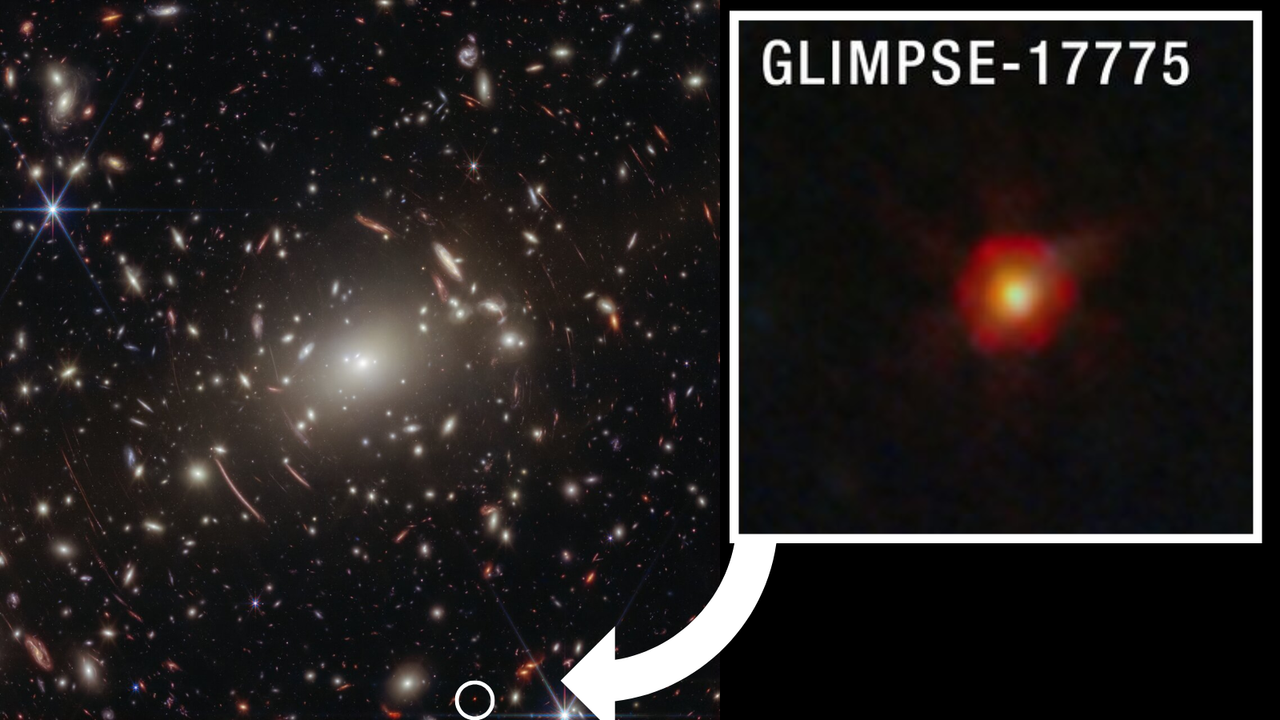
The James Webb Space Telescope has gathered fresh evidence that mysterious "little red dots" detected in the early universe are powered by supermassive black holes at the cores of infant galaxies, astronomers report.
These compact, intensely red objects puzzled researchers since JWST first spotted them in 2022. Their extreme brightness and small size defied conventional models of galaxy formation. The objects appeared far too luminous and mature for their young cosmic age, roughly 500 million to 1 billion years after the Big Bang.
New spectroscopic data from JWST reveals signatures consistent with active supermassive black holes actively consuming material. The telescope's infrared capabilities penetrate dust obscuring these distant objects, exposing the characteristic emission patterns produced by matter spiraling into black holes at the galaxy centers.
The discovery reshapes understanding of black hole growth in the early universe. Standard theory predicts supermassive black holes require billions of years to reach millions or billions of solar masses. Yet these little red dots suggest some black holes grew far faster than models allow. Either black holes formed earlier and more efficiently than anticipated, or galaxies underwent more vigorous mergers early in cosmic history.
The findings address what cosmologists call the "black hole growth problem." Detecting such massive black holes in such young galaxies forces reconsideration of how these objects assembled their enormous masses. Some researchers propose that primordial black holes, formed directly from the Big Bang itself, seeded rapid growth. Others suggest initial black holes were simply more massive than current models predict.
This work builds on earlier JWST observations confirming several little red dots contained active black holes. Subsequent studies have continued unveiling their nature through deep spectroscopy and multiwavelength imaging. Each observation chips away at the mystery surrounding these objects and their role in shaping early galactic evolution.
The James Webb Space Telescope's unmatched