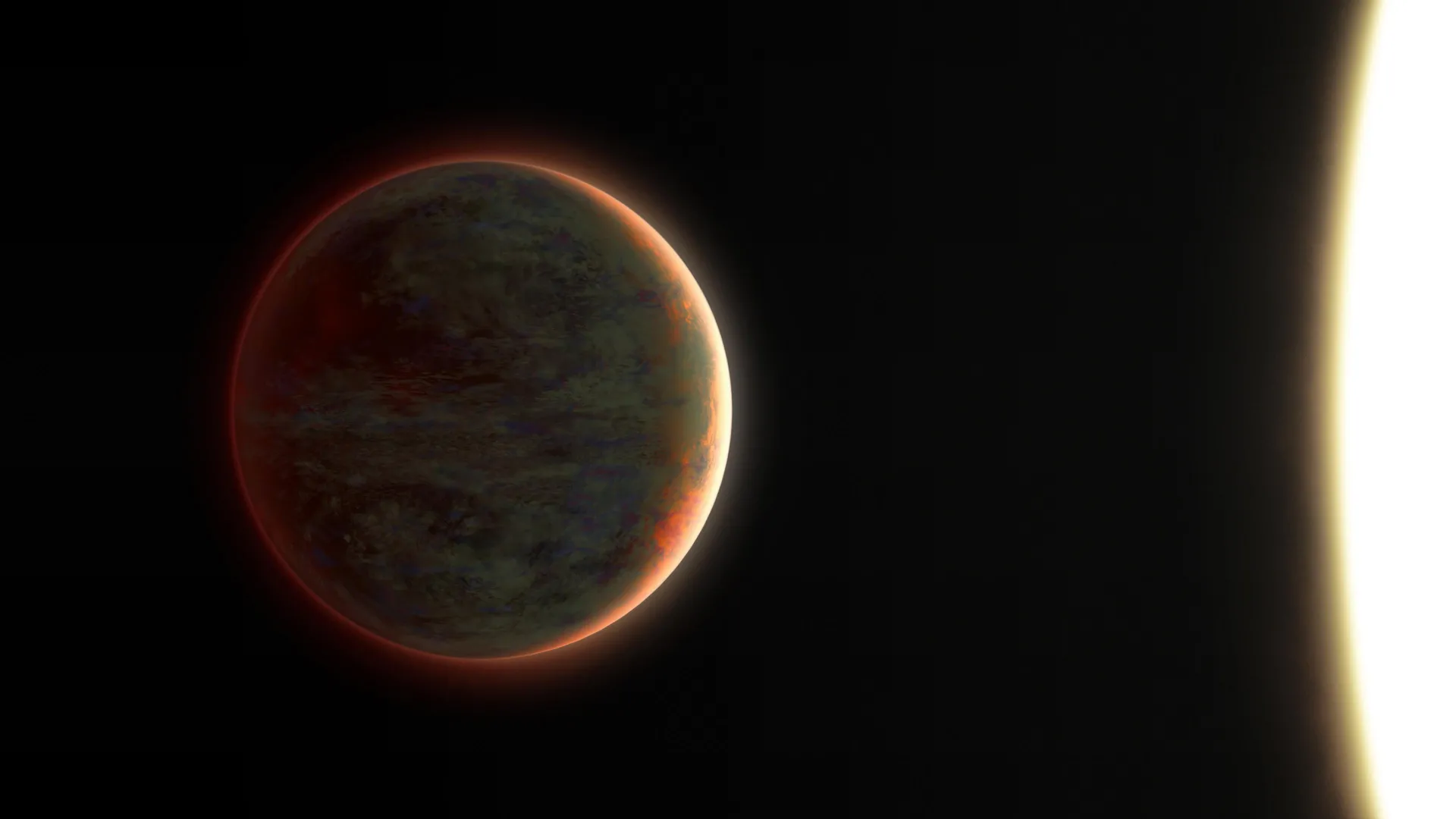
The James Webb Space Telescope has uncovered starkly asymmetrical atmospheres on the ultra-hot exoplanet WASP-121 b, revealing that dawn and dusk operate under fundamentally different physical conditions.
WASP-121 b orbits so close to its star that one side faces perpetual daylight while the other endures eternal night. Observations show the evening terminator significantly hotter and more expanded than the morning terminator, defying expectations of symmetry. Fierce winds transport heat from the scorched dayside across the planet, accumulating energy on the sunset region and creating a temperature gradient between the two twilight zones.
JWST detected water molecules fragmenting under extreme temperatures, a process called photodissociation. The intense stellar radiation splits H2O into hydrogen and oxygen atoms, fundamentally altering atmospheric chemistry on the dayside. The detection of these breakdown products provides direct evidence of atmospheric dynamics on a world roughly 1,200 light-years away.
The research team also identified mineral clouds on the cooler morning side. These condensates appear to play an outsized role in shaping atmospheric structure and composition in regions where temperatures drop enough for solid particles to form. The clouds influence heat absorption and reflection, contributing to the dawn-dusk asymmetry.
WASP-121 b presents an extreme laboratory for atmospheric science. With temperatures exceeding 2,400 Kelvin on its dayside, the planet represents conditions unlike anything in our solar system. The observations demonstrate JWST's unprecedented capability to resolve atmospheric properties across individual exoplanet terminator regions, revealing wind patterns, chemical transformations, and cloud processes once thought inaccessible to direct study.
These findings highlight how stellar irradiation and planetary rotation create dramatic local variations on tidally locked worlds. The asymmetry between dawn and dusk on WASP-121