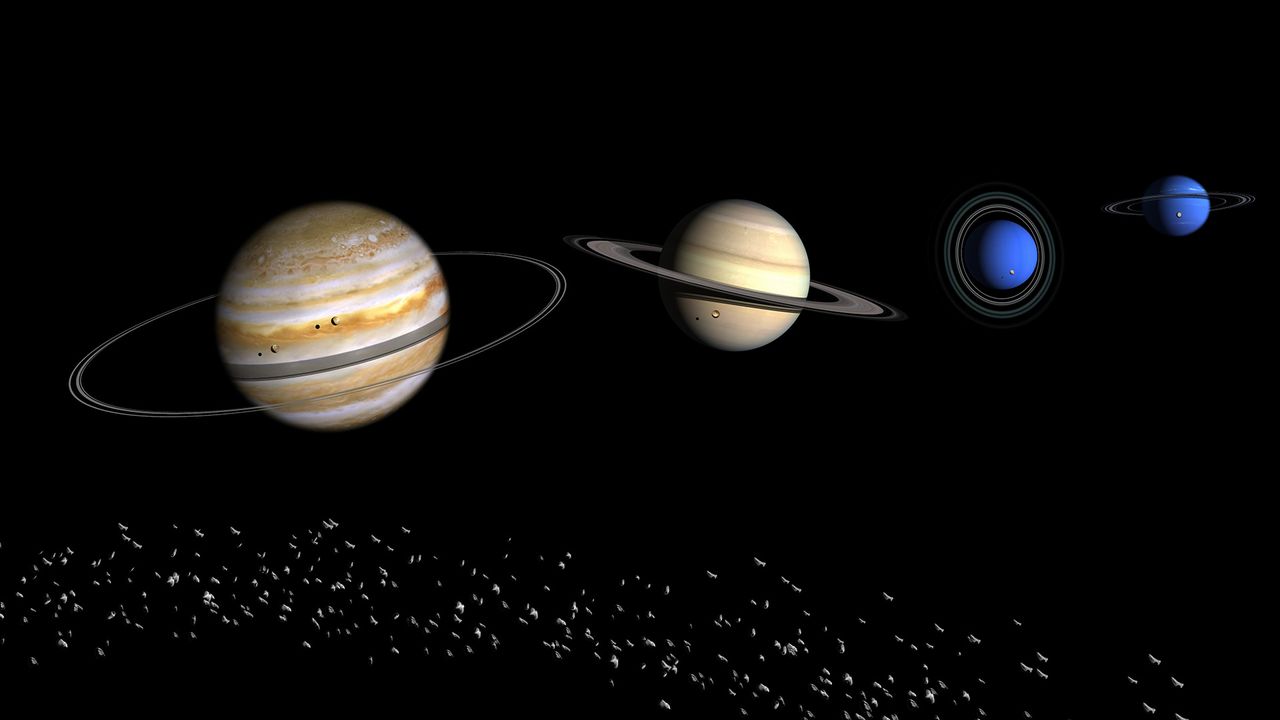
Astronomers have uncovered evidence that the early solar system contained up to six giant planets, including two "super Earths" that orbited near Neptune before vanishing billions of years ago. The discovery reshapes understanding of planetary formation during the solar system's first hundred million years.
A research team modeled the gravitational dynamics of the primordial outer solar system and found that six planets could have existed in stable orbits during this epoch. Two of these worlds, categorized as super Earths or mini-Neptunes, apparently inhabited regions close to Neptune's current orbit before being ejected into interstellar space through gravitational interactions with other planets.
The study reveals that the solar system was far more densely packed than the four giant planets Jupiter, Saturn, Uranus, and Neptune that remain today. During the early period, these massive worlds engaged in complex orbital choreography. Gravitational tugging between planets destabilized the two super Earths, eventually flinging them out of the solar system entirely.
This research builds on the "Grand Tack" and related migration models that explain how planetary orbits shifted during the solar system's infancy. These frameworks propose that giant planets migrated significantly from their original positions, causing gravitational chaos that ejected smaller bodies and reshaped the entire architecture of the system.
The findings have implications for exoplanet research. Astronomers now observe thousands of super Earths and mini-Neptunes orbiting distant stars. The new work suggests that planets in this size range may have been common in young solar systems but frequently vanished through gravitational ejection, making Earth-like survivors in mature systems relatively rare.
The study relies on computational simulations rather than direct observational evidence, a limitation acknowledged by researchers. No direct proof exists of these vanished planets. However, the gravitational consistency of the model with current planetary positions strengthens the hypothesis.