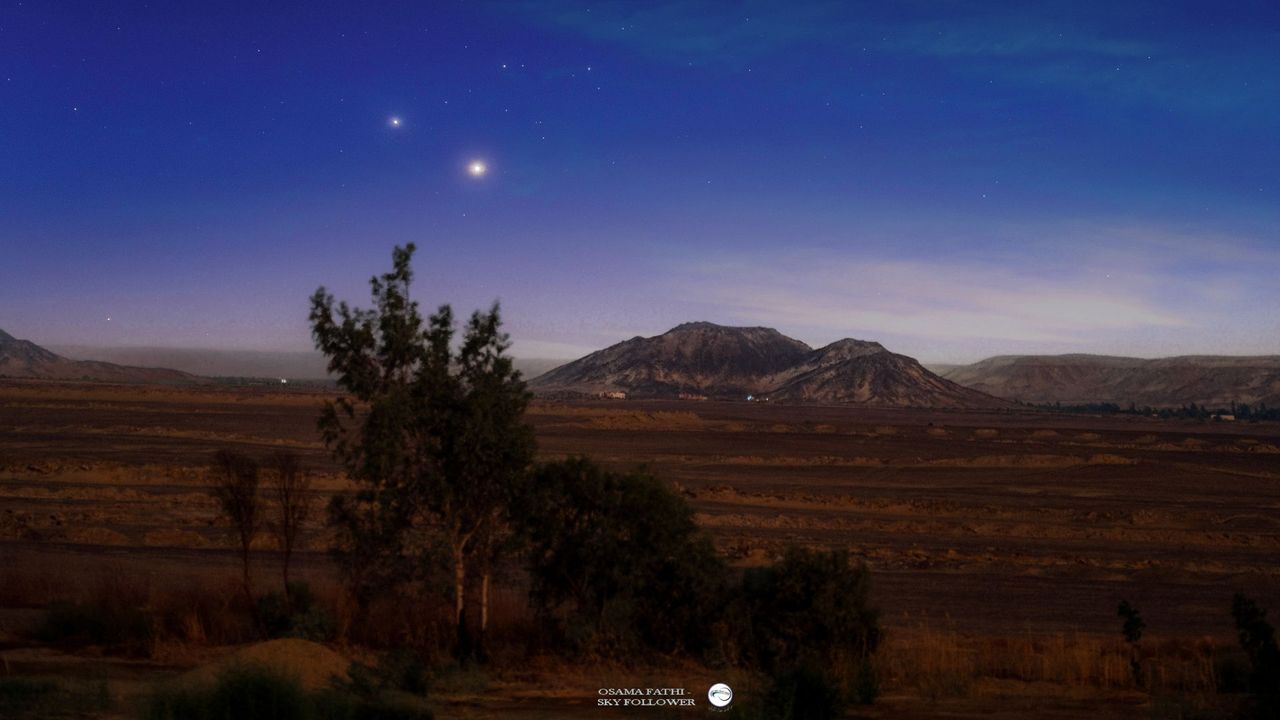
Venus and Jupiter converged in Earth's sky this week, creating a rare planetary conjunction that drew photographers and stargazers worldwide. The two brightest planets in our solar system passed within a few degrees of each other, an alignment visible to the naked eye during evening twilight hours.
Planetary conjunctions occur when two or more celestial bodies align along the same line of sight from Earth. While such events happen regularly, conjunctions between Venus and Jupiter remain among the most visually striking astronomical occurrences because both planets rank as exceptionally luminous objects in our night sky. Venus shines with an apparent magnitude of around minus 4.7, while Jupiter typically reaches minus 2.5 to minus 3.0 in brightness.
The close approach created ideal conditions for both casual observers and experienced astrophotographers. Many captured images showing the two planets separated by mere arc-minutes, occasionally appearing to touch or overlap depending on viewing location and time. Such photographs require minimal equipment. A basic camera with manual focus settings and a tripod can produce striking images of the conjunction without specialized telescopes.
Conjunctions between these particular planets carry historical weight. Astronomers have long studied such alignments, noting how ancient observers documented similar events. Some researchers have speculated that particularly dramatic conjunctions may have influenced observations recorded in historical texts, though definitive proof remains elusive.
The phenomenon stems from the planets' different orbital periods around the Sun. Venus completes an orbit every 225 Earth days, while Jupiter requires approximately 12 years. This orbital mismatch means conjunctions between these two worlds occur at irregular intervals, typically separated by several years or decades, making each encounter a special event for observers.
Cloudy skies prevented many people from witnessing the conjunction directly, yet those with clear conditions reported vivid naked-eye visibility. The spectacle served as a reminder of the dynamic celestial mechanics constantly unfolding