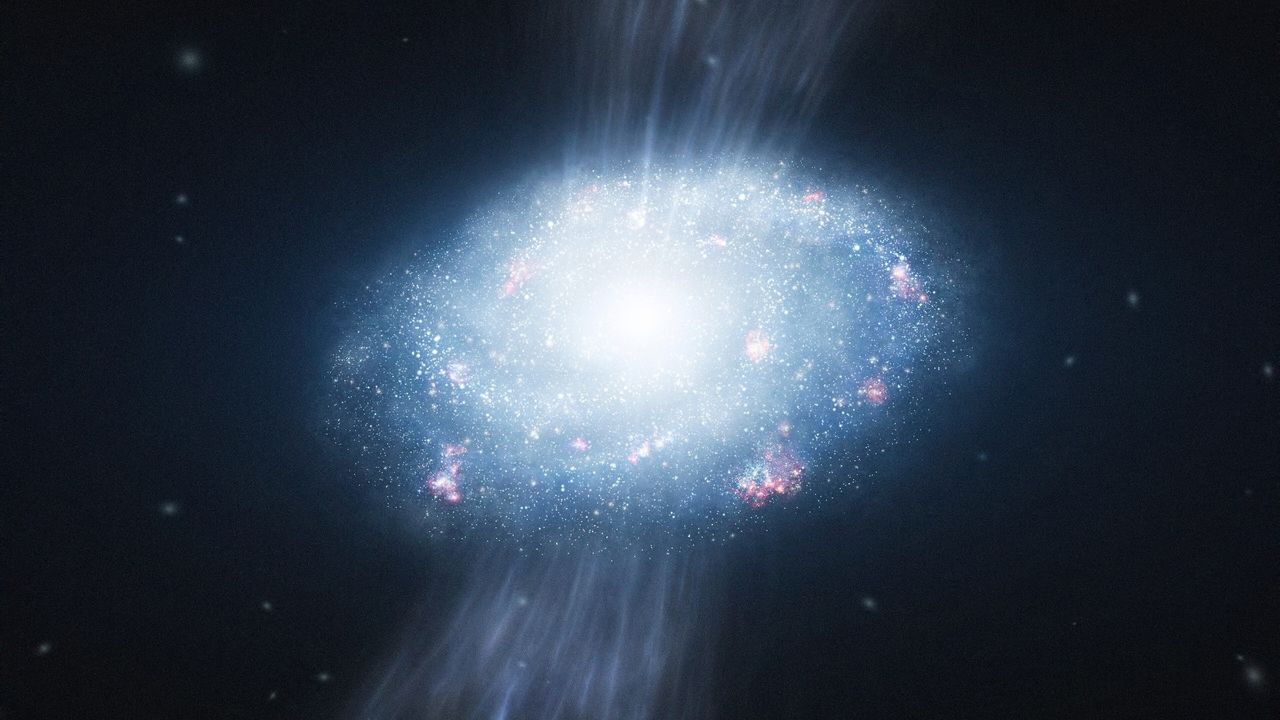
Astronomers have discovered that galaxies reach a mass threshold beyond which they cease to grow, regardless of available gas and stellar material. This observation challenges conventional models of galactic evolution and points toward an unknown mechanism that halts star formation at critical sizes.
Observations from multiple surveys show that massive galaxies stop accumulating new stars once they exceed roughly a trillion solar masses. Below this limit, galaxies continue accreting gas and converting it into new stars through normal processes. Above it, star formation drops dramatically, even when gas remains available in their environments.
The "kill switch" remains unidentified, though researchers propose several candidates. Feedback from active galactic nuclei, where supermassive black holes eject tremendous energy, ranks as the leading explanation. Supernovae explosions from massive stars could also expel gas at velocities high enough to prevent recapture. Alternatively, the formation of massive bulges or bars within galaxies might stabilize their structures in ways that suppress star formation.
The discovery matters because it reveals that galaxy growth follows rules beyond simple physics. Galaxies do not simply grow larger by accumulating more mass indefinitely. Something regulates their size. Understanding this regulation process helps astronomers model how the universe evolved from the early cosmos to today.
The evidence comes from infrared and optical surveys that measure stellar masses and star formation rates across billions of galaxies. Researchers identified the sharp transition where growth ceases. They also found that once galaxies cross this threshold, they remain in a "quiescent" state for billions of years, meaning star formation stays suppressed.
Current models struggle to explain why this threshold exists universally across galaxies of different ages and environments. Testing competing theories requires detailed observations of galaxies near the transition zone, particularly their gas content, black hole activity, and energy output.
Future observations with next-generation telescopes should clarify which feedback mechanism dominates.