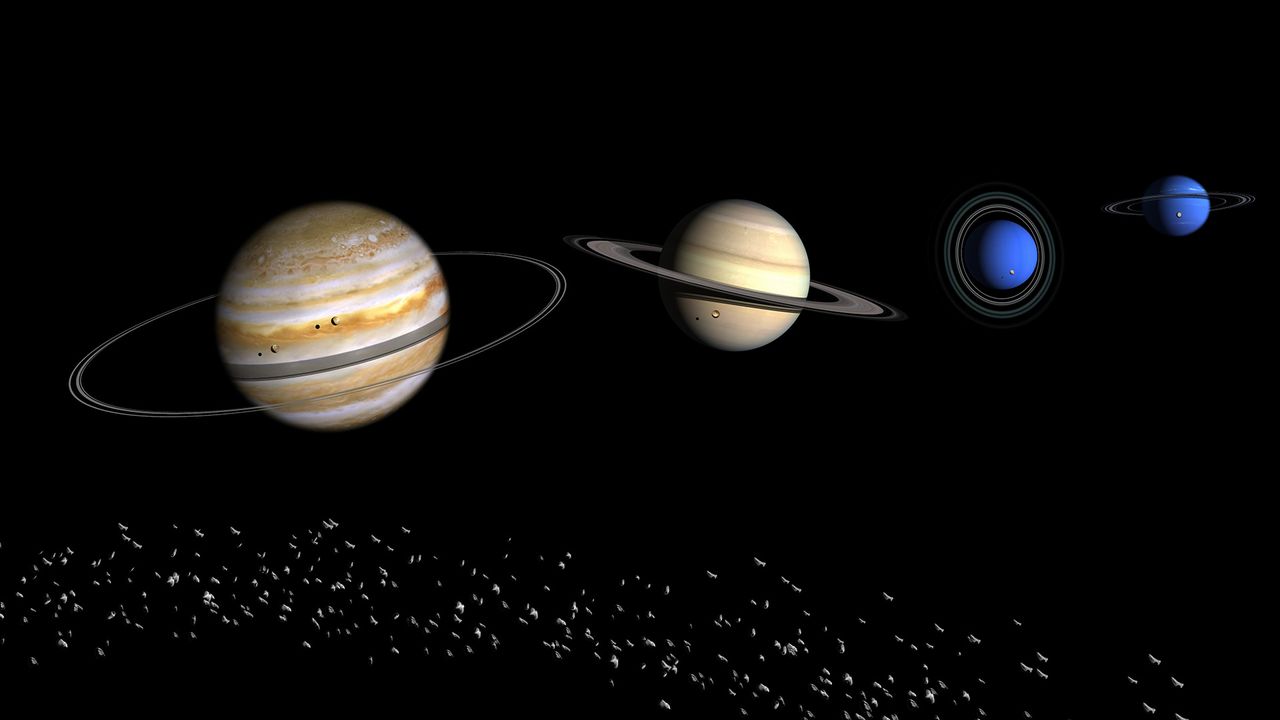
Astronomers using computational models have revealed that the early outer solar system contained up to six giant planets, including two "super Earths" that orbited between Uranus and Neptune before vanishing, according to research published recently. The discovery reshapes understanding of planetary formation and migration in our solar system's infancy.
The study, based on dynamical simulations, demonstrates that these additional planets existed within the first hundred million years after the solar system formed. Two particularly large terrestrial worlds occupied the region now inhabited by Uranus and Neptune. Over time, gravitational interactions destabilized these planets, causing them to either collide with one another, scatter outward into interstellar space, or crash into the inner solar system.
This orbital chaos left observable scars throughout the outer solar system. The gravitational upheaval disrupted the moons orbiting the gas giants, creating the irregular satellite systems we observe around Jupiter, Saturn, Uranus, and Neptune today. Many of these moons follow unusual paths or orbit backward relative to their planets' rotation, evidence preserved from this violent epoch.
The research extends earlier models proposing planetary migration. Astronomers previously suggested the solar system formed with more planetary bodies than currently exist, with Nice model simulations showing Jupiter and Saturn drifted from their original positions. This new work indicates that process was far more dramatic than earlier theories proposed.
Computer simulations reveal how primordial planets scattered gravitationally. The models show different migration pathways that would explain both the current planetary architecture and the peculiar moon systems observed. The vanished super Earths either ejected from the solar system entirely or fell into the sun during interactions with larger gas giants.
These findings have implications for understanding exoplanetary systems. Many observed around distant stars show unexpected planetary arrangements, mass distributions, and orbital configurations that models incorporating planetary migration and loss now better explain.
The study relies entirely on mathematical