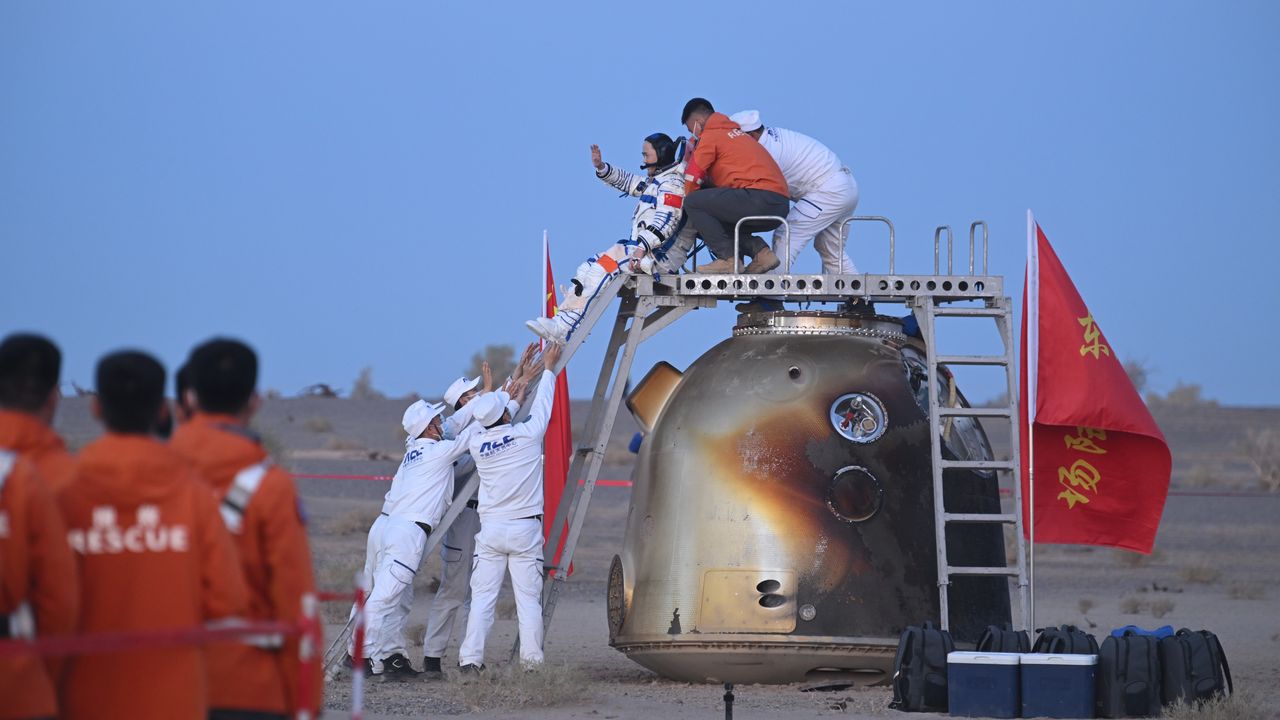
China's Shenzhou 21 spacecraft landed on Friday, May 29, bringing three astronauts safely back to Earth after completing a record-breaking mission aboard the Chinese space station. The crew had faced an unexpected challenge when their return capsule experienced a temporary communications loss, briefly leaving mission controllers without contact.
The astronauts spent approximately six months in orbit, conducting scientific experiments and performing maintenance work on the Tiangong space station. Their extended stay set a new duration record for Chinese crewed missions, underscoring Beijing's growing capabilities in human spaceflight operations.
The brief communications issue during descent raised tensions in mission control but resolved without jeopardizing crew safety. Chinese space authorities maintained redundant systems that allowed ground personnel to monitor the vehicle's trajectory and confirm the crew's condition. The capsule deployed parachutes as designed and touched down in its designated landing zone in Inner Mongolia.
This mission marks another milestone in China's ambitious space program expansion. The Tiangong station, launched in sections between 2021 and 2022, now operates as a fully crewed orbital laboratory. China has established a consistent schedule of rotating three-person crews every six months, rivaling the operational model used aboard the International Space Station.
The successful completion of Shenzhou 21 demonstrates the maturity of China's human spaceflight infrastructure, from launch systems to life support and recovery operations. Chinese space officials plan to continue regular crew rotations and expand scientific research aboard Tiangong, positioning the station as a long-term fixture in orbital operations.
The mission's record-breaking duration and the crew's safe return, despite the communications anomaly, highlight both the progress and remaining challenges in sustaining prolonged human presence in space.