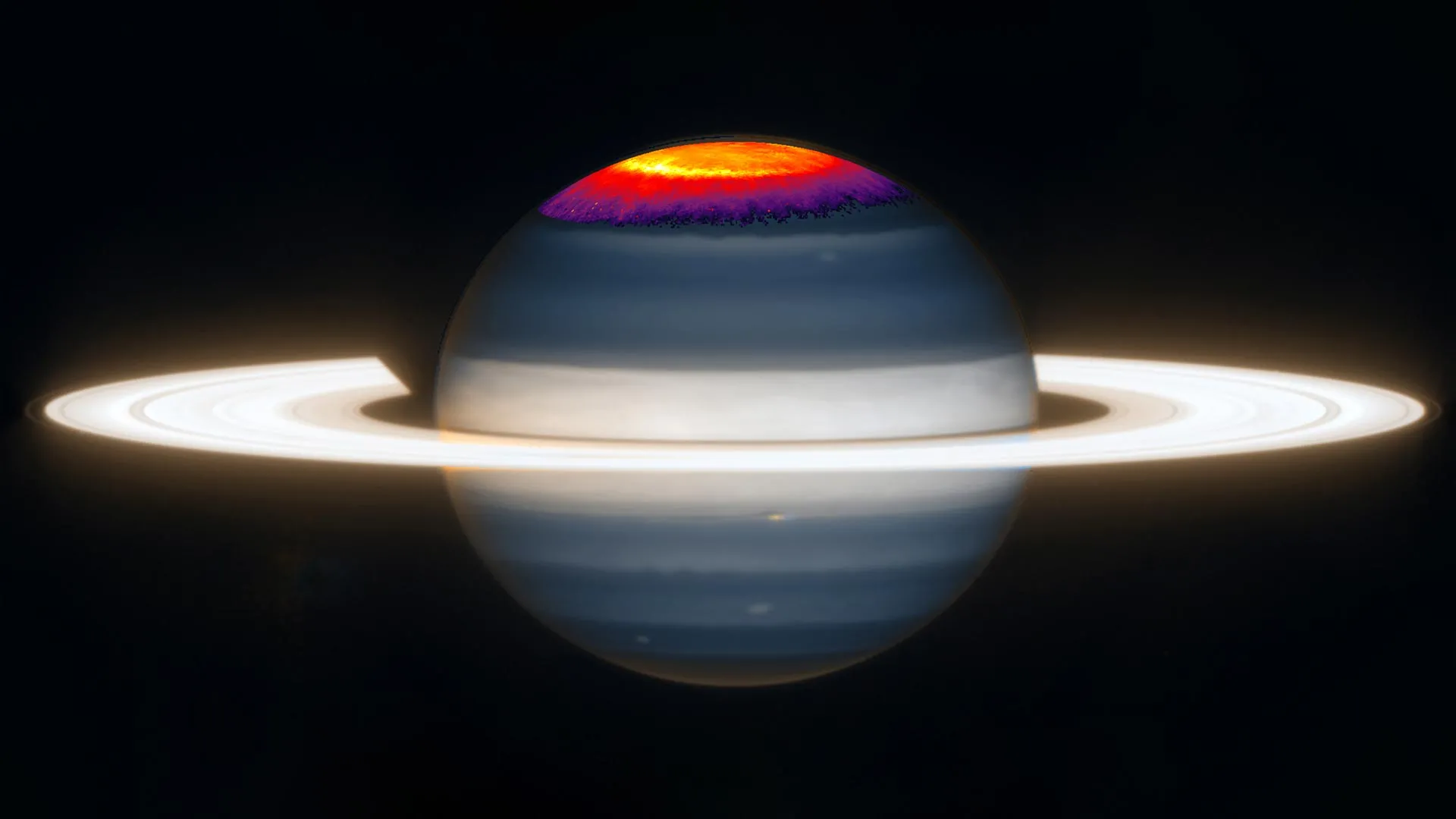
The James Webb Space Telescope has resolved a puzzle that stumped astronomers for decades. Saturn's apparent changes in rotation rate stem not from the planet itself speeding up or slowing down, but from powerful atmospheric winds, researchers found.
Webb's observations unveiled a self-sustaining cycle powered by Saturn's northern lights. The aurora actively heats the planet's upper atmosphere, which generates winds. These winds create electrical currents that energize the aurora across Saturn's entire polar region, completing the loop.
Previous measurements suggested Saturn's rotation varied by up to 20 minutes between observations separated by years. This inconsistency challenged astronomers because planetary rotation should remain relatively constant. The leading hypothesis blamed seasonal changes or internal processes, but neither explained the full pattern.
Webb's infrared instruments pierced Saturn's cloud layers with clarity impossible from earlier telescopes. The data showed that atmospheric dynamics, not planetary spin, account for the observed variations. The heating of atmospheric gases by auroral activity generates wind patterns strong enough to affect how the planet appears to rotate when viewed from Earth.
The discovery reveals an intricate coupling between Saturn's magnetosphere and its atmosphere. The aurora represents energy flowing from the planet's magnetic field into the upper atmosphere. Rather than dissipating as heat alone, this energy drives circulation patterns that feed back into the auroral system itself.
This feedback mechanism explains why Saturn maintains such vigorous auroral activity despite being five times farther from the sun than Earth. The self-sustaining nature of the cycle means the aurora does not require continuous external energy input to persist.
The finding carries implications for understanding planetary atmospheres and magnetospheres throughout the solar system. Similar mechanisms may operate at Jupiter and potentially on exoplanets with strong magnetic fields. The study demonstrates how the most advanced space telescopes can resolve longstanding questions by providing unprecedented resolution of planetary features across infrared wavelengths.