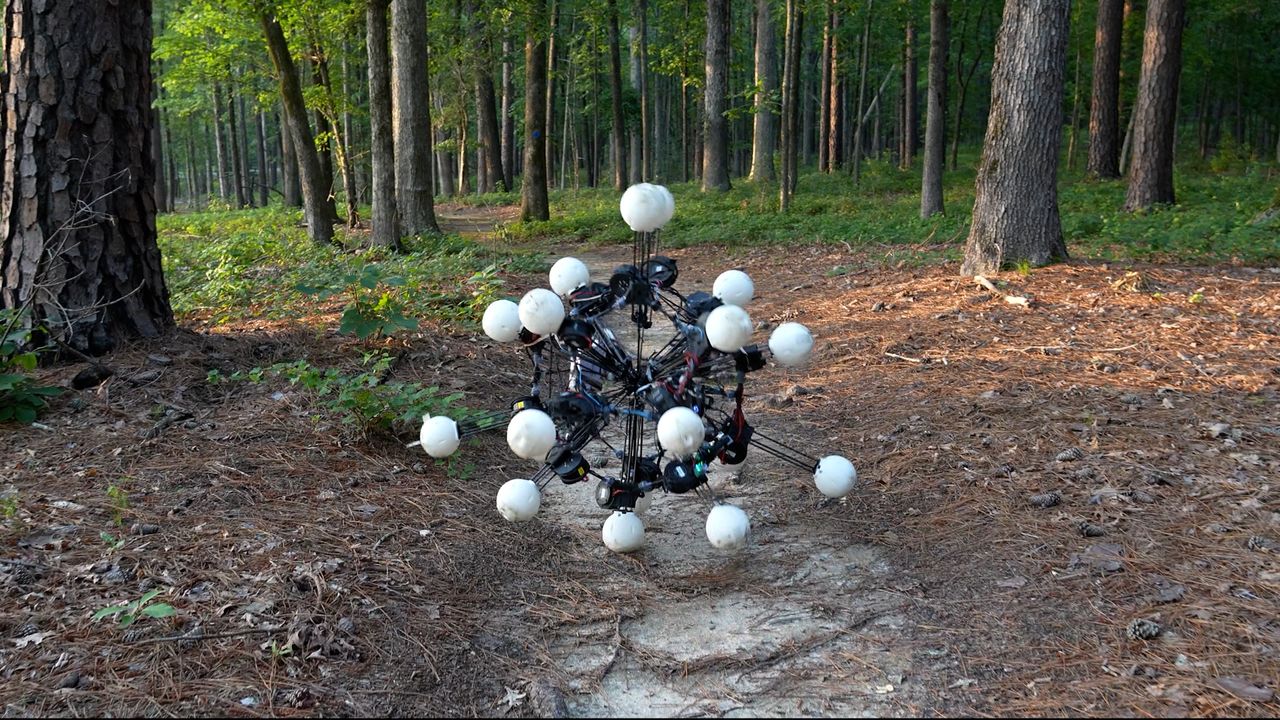
Researchers have identified an unexpected design principle for robotic locomotion. A sea-urchin-inspired robot with 20 legs outperforms traditional four- or six-legged designs across diverse terrains and obstacles, according to new findings presented in robotics research.
The 20-legged morphology allows the robot to navigate complex environments with exceptional versatility. The design enables the machine to climb vertical walls, traverse dense vegetation, and move across uneven ground without sacrificing speed or stability. Each leg operates semi-independently, distributing weight and adapting to terrain changes in real time.
This research builds on biomimetic engineering principles, where scientists copy solutions found in nature. Sea urchins use their numerous tube-like feet for movement across ocean floors and rocky surfaces. Engineers translated this biological model into a robotic platform with similar distributed locomotion architecture.
The study challenges conventional robotics wisdom that favors minimalist leg counts. Four-legged robots often excel on flat ground but struggle with obstacles. Six-legged designs offer better terrain negotiation. The 20-legged system appears to solve a fundamental tradeoff between speed and adaptability by distributing the control problem across more independent units rather than centralizing it in fewer, more complex limbs.
The robot's climbing and tree-traversal capabilities demonstrate practical applications beyond laboratory settings. Potential uses include search-and-rescue operations in disaster zones, environmental monitoring in remote forests, and inspection tasks in industrial facilities with complex geometries.
Researchers acknowledge limitations in their current prototype. The increased leg count raises power consumption concerns and manufacturing complexity. Processing coordination across 20 limbs requires sophisticated control algorithms, though distributed neural networks show promise for reducing computational overhead.
The work suggests that optimization in robot design may not always favor simplicity. Nature's solutions, refined through millions of years of evolution, often incorporate apparent redundancy that actually solves multiple problems