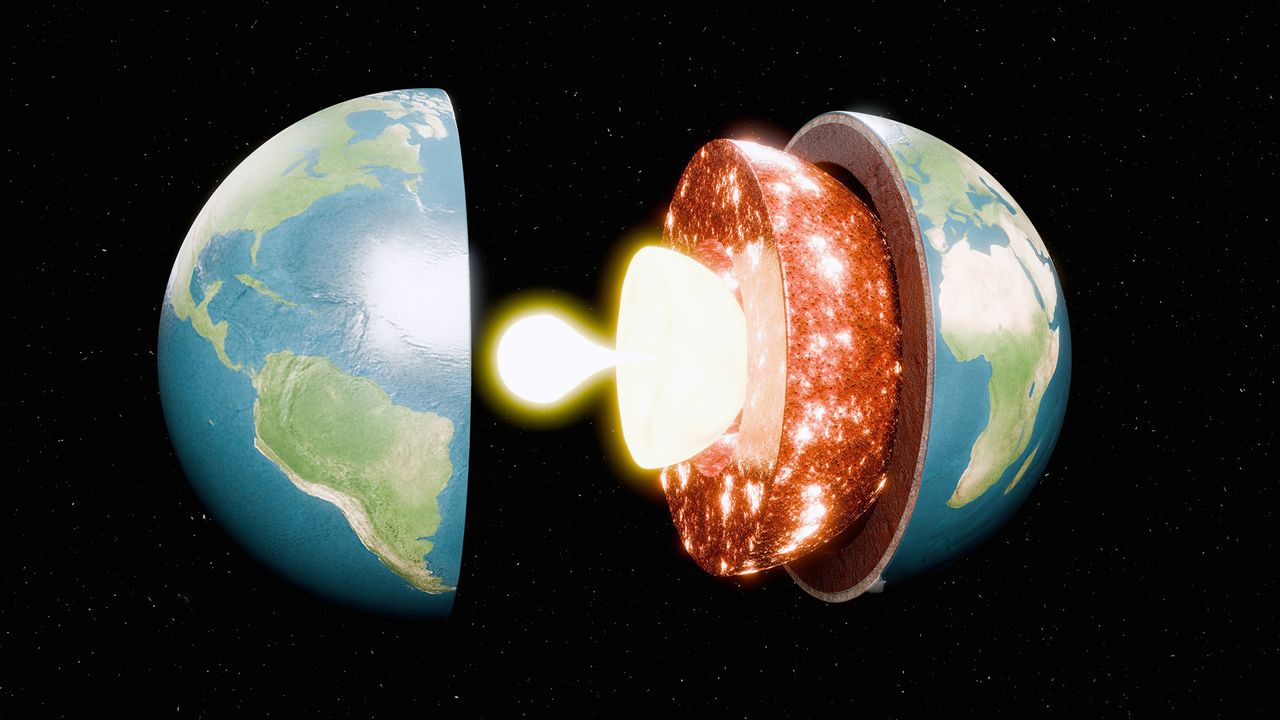
Scientists have long debated the exact temperature of Earth's core, but recent research has narrowed down estimates through sophisticated laboratory experiments and seismic analysis. The inner core, Earth's solid iron center, reaches temperatures between 9,000 and 10,000 Kelvin (roughly 8,700 to 9,700 degrees Celsius or 15,700 to 17,500 degrees Fahrenheit), comparable to the surface of the sun.
Researchers determine core temperatures using multiple methods. High-pressure experiments recreate the crushing forces found thousands of kilometers below the surface, allowing scientists to measure how iron and nickel behave under extreme conditions. Seismic waves from earthquakes provide another window into Earth's interior, revealing how sound travels through different layers and indicating their composition and temperature.
The outer core, a liquid layer surrounding the inner core, runs slightly cooler at approximately 4,000 to 9,000 Kelvin. This temperature difference drives the convection currents that generate Earth's magnetic field, protecting us from solar radiation and charged particles.
Understanding core temperature matters for planetary science and geology. It constrains models of how Earth formed, evolved, and continues to change. The heat radiating from the core powers plate tectonics, volcanism, and mountain building. Accurate measurements also help scientists studying other planets gauge their internal heat and potential for geological activity.
Previous temperature estimates varied wildly. Older measurements suggested core temperatures as low as 5,000 Kelvin, while some studies pushed toward 7,000 Kelvin. Advances in diamond anvil cells and computational modeling have refined these numbers considerably. Synchrotron radiation facilities, which produce intense X-rays, let researchers observe iron under core-like pressures and temperatures simultaneously.
The 9,000 to 10,000 Kelvin range now represents