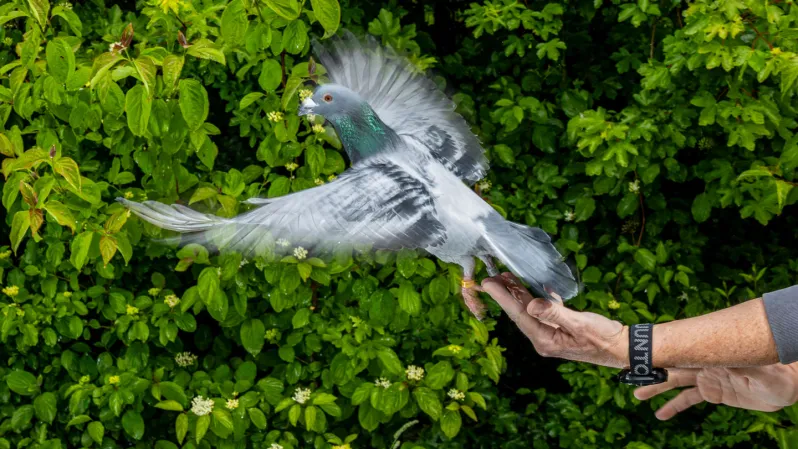
Researchers studying homing pigeons have identified an unexpected biological mechanism for magnetic navigation. Iron-laden immune cells in the liver may serve as the birds' internal compass, according to new findings.
The discovery challenges prevailing theories about how animals sense Earth's magnetic field. Scientists have long debated whether birds detect magnetism through proteins in their eyes, quantum effects in specialized cells, or other mechanisms. This research redirects attention to a simpler structure: immune cells called macrophages that accumulate iron.
The study examined pigeon livers and found these macrophages contain high concentrations of iron-rich compounds. When exposed to magnetic fields in laboratory conditions, the cells responded predictably to directional changes. Researchers propose that clusters of these iron-laden cells could function as biological magnetometers, generating signals the nervous system interprets as directional cues.
The mechanism works through basic physics. Iron particles align with Earth's magnetic field, much like compass needles. If pigeon brains can detect the physical orientation of liver macrophages, they gain a reliable navigation reference without requiring exotic quantum processes or light-dependent proteins.
The research raises questions about why the liver specifically houses this navigational system. One hypothesis suggests that macrophages evolved iron-accumulation functions for immune purposes, and birds secondarily exploited this trait for navigation. This represents biological repurposing rather than specialized adaptation.
The findings remain preliminary. Laboratory observations of isolated cells do not prove pigeons use this mechanism in nature. Field tests tracking wild pigeons with experimental liver damage or iron depletion would strengthen the case. Additionally, the iron-compass hypothesis does not necessarily exclude other magnetic-sensing mechanisms operating simultaneously in different tissues.
The discovery aligns with emerging evidence that animal navigation often involves multiple redundant systems. Pigeons may combine magnetic sensing from liver cells with visual landmarks, solar position, olfactory cues, and other sensory inputs