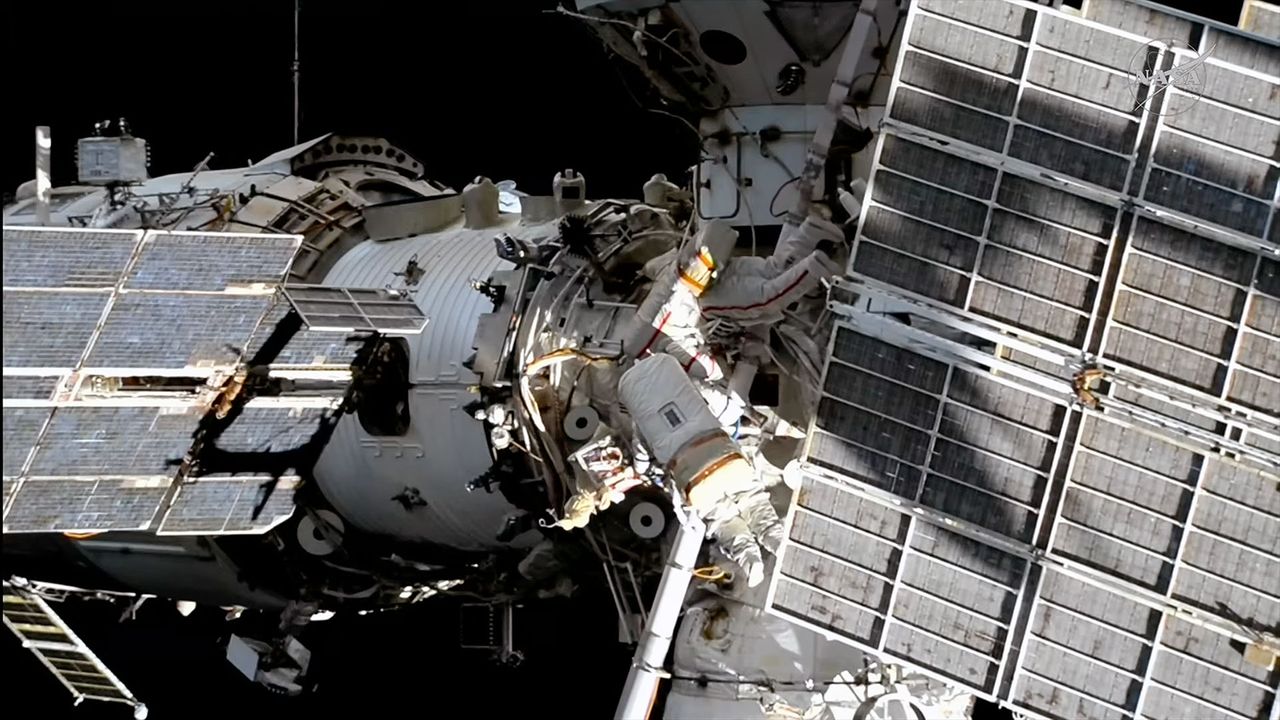
Russian cosmonauts Sergey Kud-Sverchkov and Sergei Mikaev completed a six-hour spacewalk outside the International Space Station on May 27, 2026, to install a new solar observation telescope and conduct routine maintenance tasks.
The pair worked methodically through their checklist, deploying the sun-watching instrument designed to monitor solar activity and atmospheric interactions. This addition to the ISS expands the station's Earth and space science capabilities, allowing researchers to gather continuous data on solar phenomena that influence Earth's climate and space weather.
Spacewalks of this duration demand precise coordination and preparation. The cosmonauts operated from the Russian segment of the station, where Mikaev and Kud-Sverchkov maneuvered in microgravity to position the telescope at designated mounting points. The installation required securing electrical connections and ensuring the instrument's sensors faced the sun without obstruction from station hardware.
Beyond the telescope deployment, the cosmonauts retrieved several completed science experiments for return to Earth. These materials will undergo analysis to assess how prolonged exposure to the space environment affected their properties, data relevant to long-duration spaceflight and future deep-space missions.
Russian spacewalks occur less frequently than American extravehicular activities, making this operation noteworthy for maintaining the ISS's research infrastructure. The Russian segment relies on periodic maintenance and upgrades to ensure its scientific instruments function effectively throughout the station's operational lifetime.
The spacewalk proceeded without complications, allowing ground controllers and the crews' commanders aboard the ISS to monitor progress continuously. Kud-Sverchkov and Mikaev have logged hundreds of hours in space between them, bringing experience critical to complex external operations in the hazardous environment beyond the station's protective hull.
This mission adds to the growing body of solar data collected continuously from orbital platforms, complementing observations from dedicated