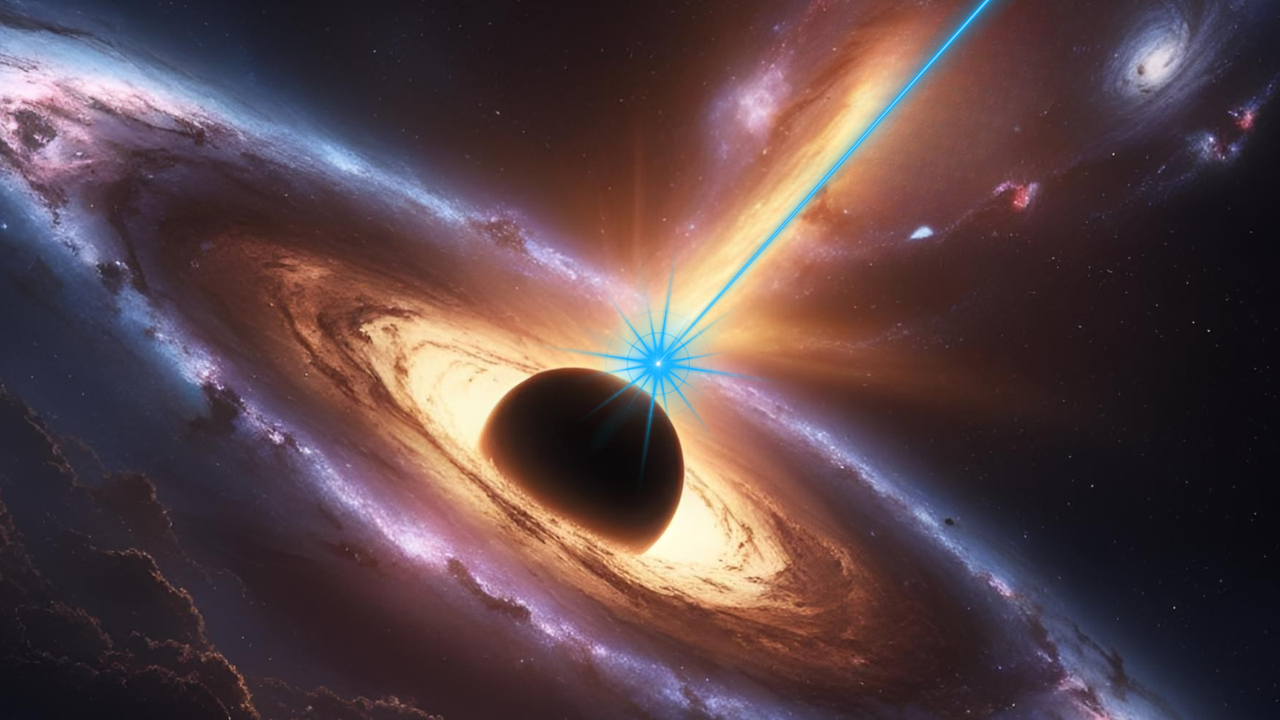
Astronomers have detected the most energetic neutrino ever observed, and new analysis suggests it originated from a blazar powered by a supermassive black hole. The findings point to blazars as extreme cosmic particle accelerators capable of producing some of the universe's most energetic phenomena.
Blazars are galaxies with supermassive black holes at their centers that expel jets of particles at nearly the speed of light, directed toward Earth. When these jets accelerate particles to extreme energies, they can produce high-energy neutrinos, the ghostly particles that barely interact with ordinary matter and travel nearly unobstructed across the cosmos.
The detection of this record-breaking neutrino represents a breakthrough in multimessenger astronomy, which combines observations from different types of particles and radiation to understand cosmic events. While light and gravitational waves fade over distance, neutrinos preserve information about their source's conditions, making them valuable probes of the most violent cosmic engines.
The black hole at a blazar's center acts as a natural particle accelerator. As material spirals inward toward the black hole, some matter gets funneled into jets that achieve relativistic speeds. Within these jets, particles collide and interact, producing secondary particles including neutrinos. The fact that such energetic neutrinos reach Earth suggests the acceleration mechanisms in blazars operate with remarkable efficiency.
This discovery has limitations. Confirming the blazar source requires additional observations and cross-referencing with other telescopes. A single detection, while striking, leaves room for alternative interpretations. Scientists will need to observe more high-energy neutrinos and their associated blazars to establish definitively that these objects are primary sources.
The finding opens new windows into understanding how black holes transform gravitational energy into kinetic energy and accelerate particles to extreme velocities. Future observations with upgraded neutrino detectors and expanded astronomical surveys should reveal