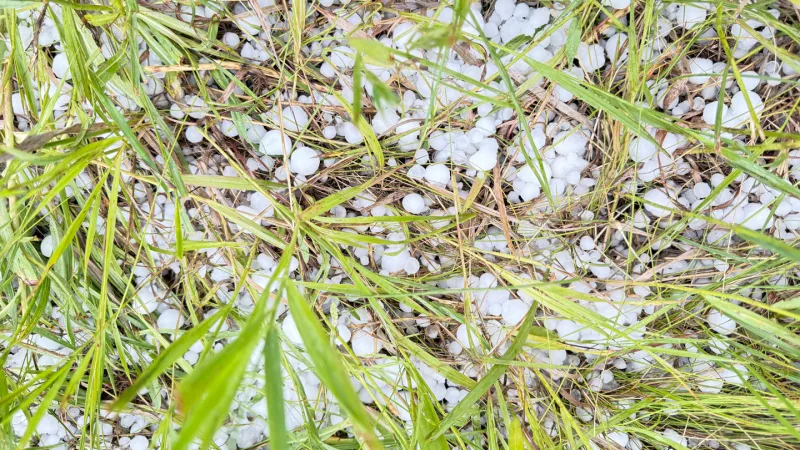
Climate change may intensify hailstorm severity across mid-to-high latitudes, according to a global modeling study. Researchers found that warming temperatures create atmospheric conditions favorable to larger hailstone formation, potentially producing grapefruit-sized ice balls in regions currently experiencing smaller hail.
The mechanism involves the interaction of warmer air with upper atmosphere dynamics. As the planet warms, the lower atmosphere retains more moisture while upper atmospheric layers remain cool at higher altitudes. This vertical temperature gradient strengthens the updrafts in thunderstorms, allowing water droplets to circulate longer within storm clouds and accumulate more ice layers before falling. Larger hailstones result from extended residence time in these powerful updrafts.
The study analyzed climate model projections across multiple scenarios and geographic regions. Results indicate that areas spanning the Great Plains, central Europe, and parts of Asia face elevated risk of increased hail frequency and size. Regions at lower latitudes showed less dramatic changes in hail intensity.
Current hail damage costs billions annually in insurance claims and agricultural losses. Grapefruit-sized hail causes severe damage to vehicles, roofs, and crops. The research suggests these costs could rise substantially if projections hold.
The work carries important limitations. Global climate models operate at coarse spatial resolution, approximately 100 kilometers. Hail formation occurs at scales of hundreds of meters, requiring downscaling techniques that introduce uncertainty. Regional variations in terrain, soil moisture, and atmospheric stability may modulate actual changes differently than models predict. Additionally, the relationship between warming and extreme hail remains an active research area with incomplete understanding of all contributing factors.
The findings underscore the need for improved infrastructure resilience and agricultural practices in regions expected to experience more severe hail. Insurance models may require adjustment to reflect changing risk patterns. Further research at higher spatial resolution and with improved parameterization of microphysical