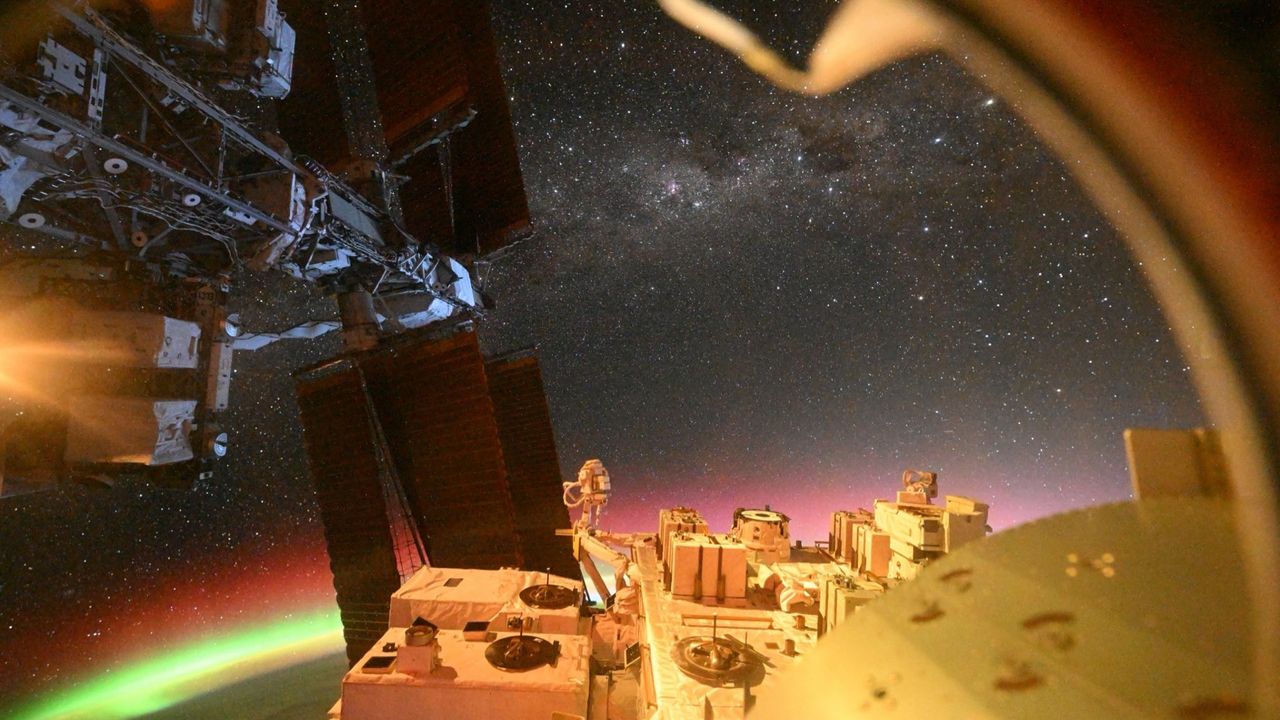
An astronaut aboard the International Space Station captured a striking image of Earth's aurora during a recent orbital pass, showcasing the ethereal light display from an altitude of roughly 250 miles above the planet's surface.
The photograph reveals the characteristic green and purple hues of the aurora borealis, created when charged particles from the solar wind collide with gases in Earth's upper atmosphere. Oxygen atoms produce the dominant green glow, while nitrogen generates the rarer purple tones visible in portions of the image.
Auroras occur in oval-shaped zones centered near Earth's magnetic poles, where the planet's magnetosphere funnels solar particles into the upper atmosphere. The phenomenon intensifies during periods of high solar activity, when the sun ejects more energetic particles toward Earth. Current solar conditions have produced particularly vivid auroral displays in recent months.
ISS astronauts possess a unique vantage point for observing auroras. From their orbital position, they witness the light show from the side rather than from beneath it, revealing the three-dimensional structure of the phenomenon. Photographs taken from the station provide scientists with valuable data about the spatial extent and intensity of auroral events.
The image documents what researchers track through ground-based magnetometer networks and satellite instruments. Data from auroral observations helps scientists understand how energy from the sun couples with Earth's magnetic field and atmosphere. This knowledge contributes to forecasting space weather events that can affect power grids, communications systems, and satellites in orbit.
Astronauts have documented auroras extensively during five decades of space station operations and earlier missions. Their photographs supplement instrumental measurements and offer visual documentation of how these displays vary with changing solar conditions. The images also capture public imagination, demonstrating Earth's dynamic interaction with the solar environment from perspectives impossible to achieve from the ground.