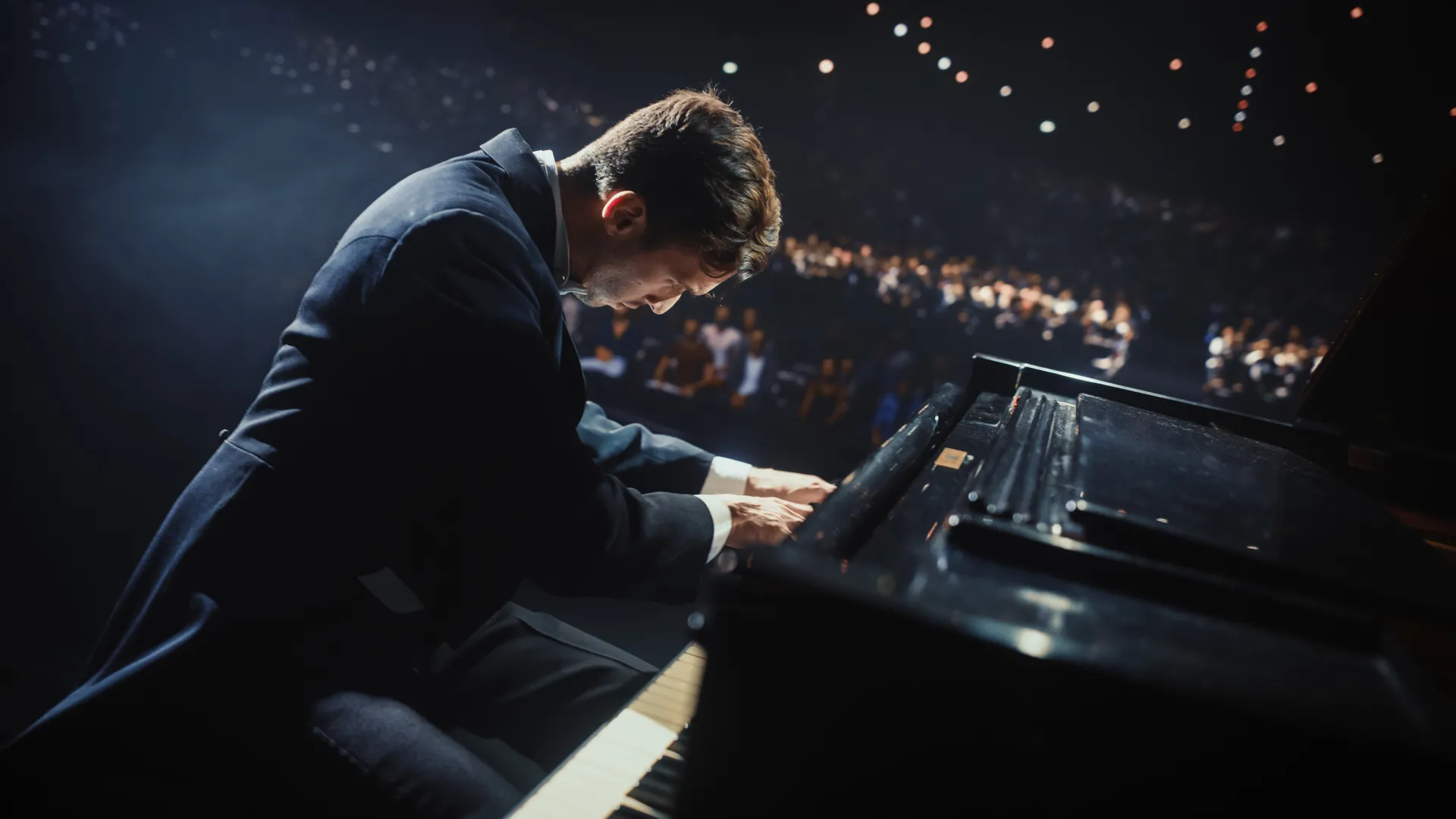
Scientists have solved a century-old debate about piano performance: a musician's touch genuinely shapes the tone color of notes, not just their volume. Researchers used high-speed motion capture sensors recording at 1,000 frames per second to reveal that elite pianists execute subtle key manipulations that produce audible differences listeners can detect.
The discovery ends decades of disagreement among pianists and music educators about whether "touch" represents real physics or merely psychological perception. The sensor system tracked precisely how skilled performers decelerate and control their fingers during the final milliseconds before and after keys strike strings. These micro-movements vary among pianists and create measurable acoustic differences.
The research demonstrates that what musicians call "tone color" or "timbre" stems from reproducible technical skill, not imagination. Even untrained listeners identified differences in recordings made with identical pianos but different pianists using the high-speed motion data. This validates the classical music training tradition emphasizing finger technique as essential to artistic expression.
The findings have practical implications for music education and performance. Students now have scientific evidence supporting their teachers' insistence on refined touch control. Recording engineers and acoustic researchers gain objective data about how performance technique translates into sound.
The study builds on earlier work in piano acoustics but represents the first rigorous biomechanical analysis linking specific finger movements to perceptible tonal variation. Previous research had documented that piano touch matters, but lacked the temporal resolution to identify exactly which movements created the differences.
Limitations remain. The research focused on elite pianists, leaving questions about whether intermediate players produce similar effects. The study also examined specific piano models, so results may not generalize across all instruments. Additionally, the mechanism explaining how these micro-manipulations alter sound physics deserves deeper investigation.
The work connects music performance to biomechanics and acoustics, bridging humanistic and scientific domains. Pianists worldwide now possess empir