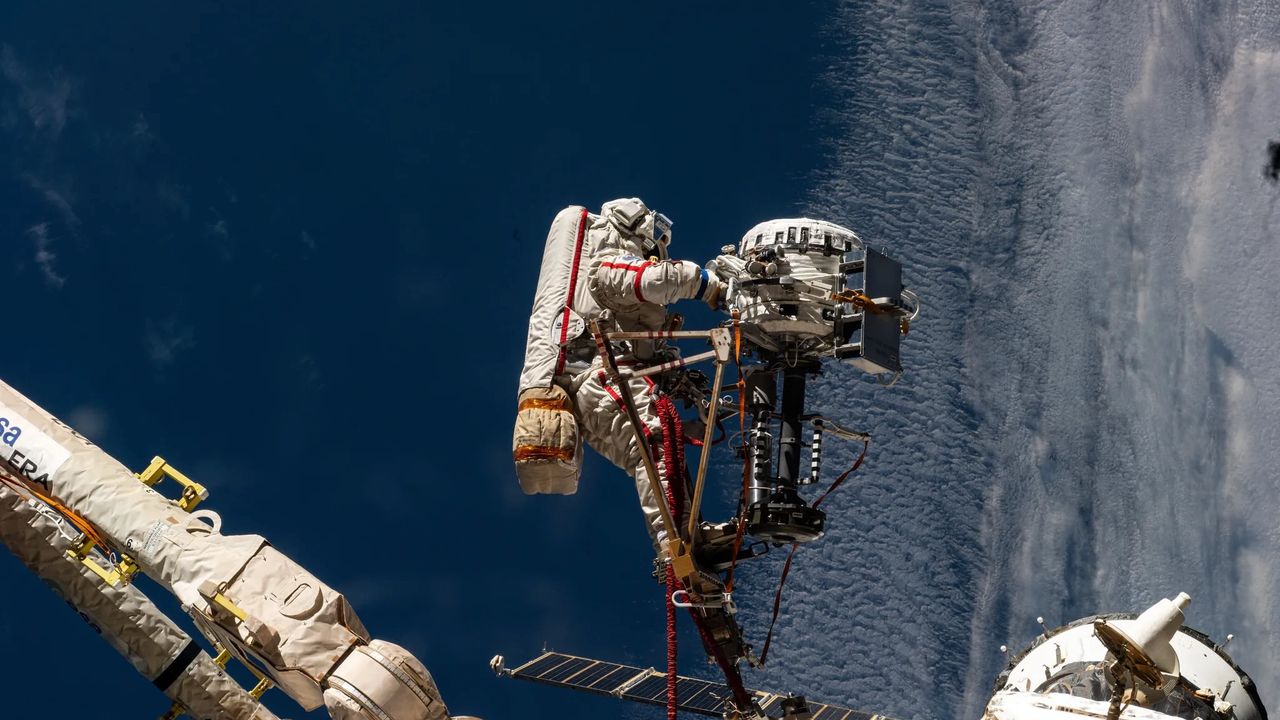
Two Russian cosmonauts conducted a five-hour spacewalk outside the International Space Station on May 27. Sergey Kud-Sverchkov and Sergei Mikaev ventured into the vacuum of space to perform maintenance and operational tasks aboard the orbital outpost.
The spacewalk, officially called an extravehicular activity or EVA, represented routine work necessary to keep the ISS functioning. Russian cosmonauts regularly conduct such operations to service equipment, install upgrades, and perform repairs that cannot be completed from inside the station. The five-hour duration falls within typical spacewalk timeframes, which generally range from five to eight hours depending on task complexity.
Kud-Sverchkov and Mikaev suited up in Russian Orlan spacesuits, which provide life support, pressure regulation, and thermal protection in the harsh environment outside the station. The suits weigh roughly 280 pounds on Earth but function differently in microgravity, where weight becomes irrelevant and mobility depends on proper training and equipment design.
The ISS maintains a continuous crew rotation system. Cosmonauts, astronauts, and other space professionals take turns aboard the orbiting laboratory, which sits approximately 250 miles above Earth's surface. Spacewalks occur regularly as part of standard maintenance schedules and unexpected repair needs that arise during the station's operation.
Live coverage of the event was available through Space.com and other space news outlets, allowing the public to watch the cosmonauts work in real-time via NASA TV feeds or other broadcast channels. Such transparency in space operations helps maintain public interest in human spaceflight and demonstrates the technical capabilities of space agencies.
The collaboration between Russian space agencies and other international partners continues despite geopolitical tensions elsewhere. The ISS remains a joint effort involving Russia, the United States, Europe, Japan, and Canada, though recent years have seen