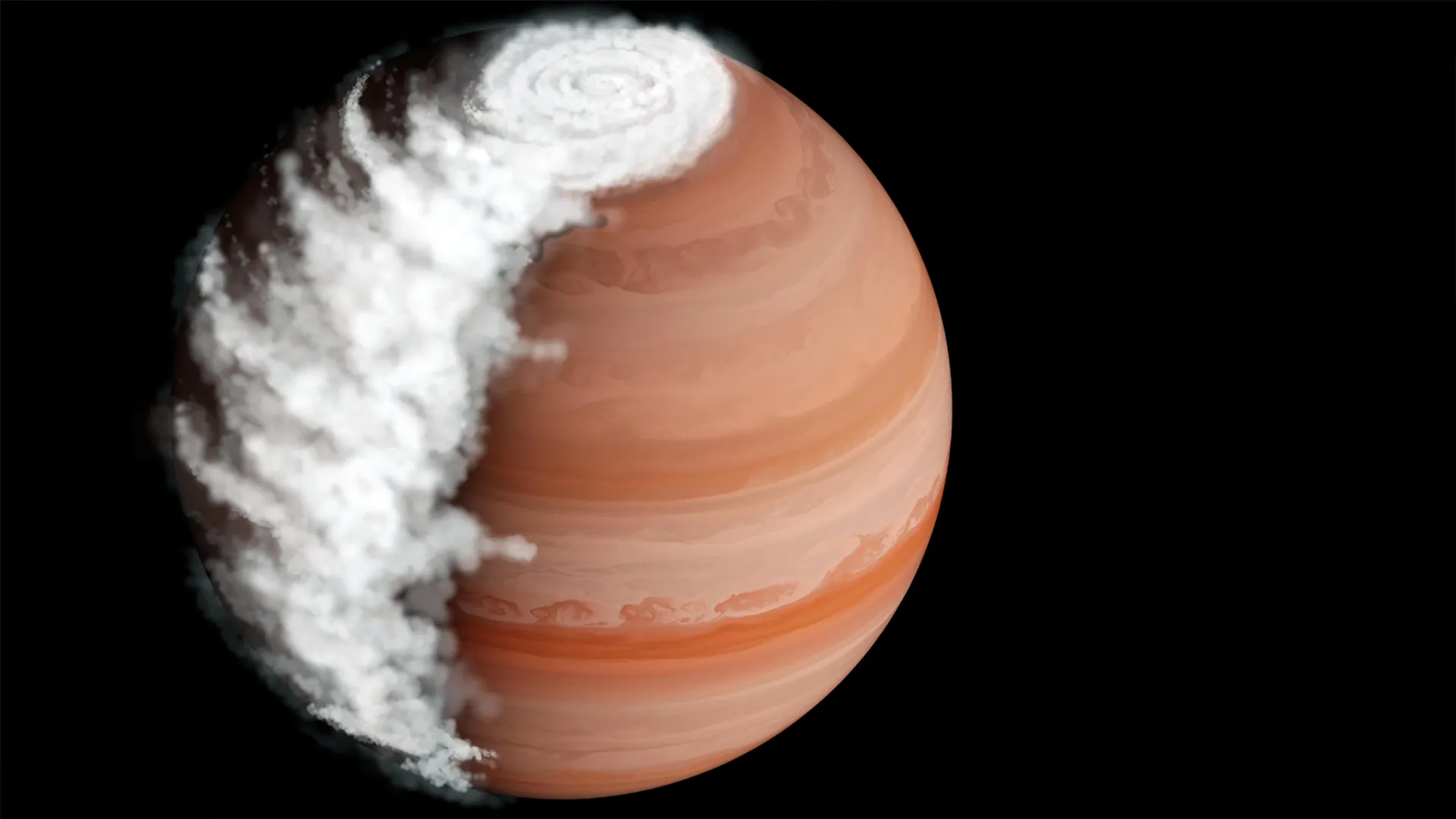
Using the James Webb Space Telescope, astronomers have discovered a giant exoplanet with an extraordinary atmospheric cycle where mineral clouds form each morning and completely evaporate by evening. The planet, WASP-94A b, orbits a star roughly 700 light-years from Earth and exhibits weather patterns fundamentally different from anything in our solar system.
The research team observed that the exoplanet's atmosphere undergoes dramatic daily transformations. Rock-like mineral clouds develop during the planet's daytime hours, then vanish entirely as night approaches, creating a cycle of opacity and clarity that repeats each rotation. This discovery provides astronomers with unprecedented detail about the composition and behavior of gases and particles in an alien atmosphere.
The findings reveal that WASP-94A b shares more characteristics with Jupiter than scientists previously understood. The planet's atmosphere contains silicate minerals that condense into clouds under specific temperature and pressure conditions. As the planet rotates away from its host star, cooling temperatures cause these clouds to dissipate, leaving clear atmospheric windows that allow direct observation of deeper atmospheric layers.
This research advances the field of exoplanet characterization by demonstrating how thermal cycles drive cloud formation and destruction on worlds beyond our solar system. Webb's infrared capabilities proved essential for tracking these atmospheric changes, detecting shifts in thermal emission that betray cloud presence or absence across different local times on the planet's surface.
The discovery carries implications for understanding how Giant planets form and evolve atmospherically. Scientists can now infer that chemical composition, temperature gradients, and rotation rates work together to create observable weather patterns on distant worlds. Future observations of WASP-94A b and similar planets may reveal whether this cloud cycle represents a common phenomenon among hot Jupiters or a unique characteristic of this system.
The research underscores Webb's capacity to resolve dynamic atmospheric processes on exoplanets, opening new avenues