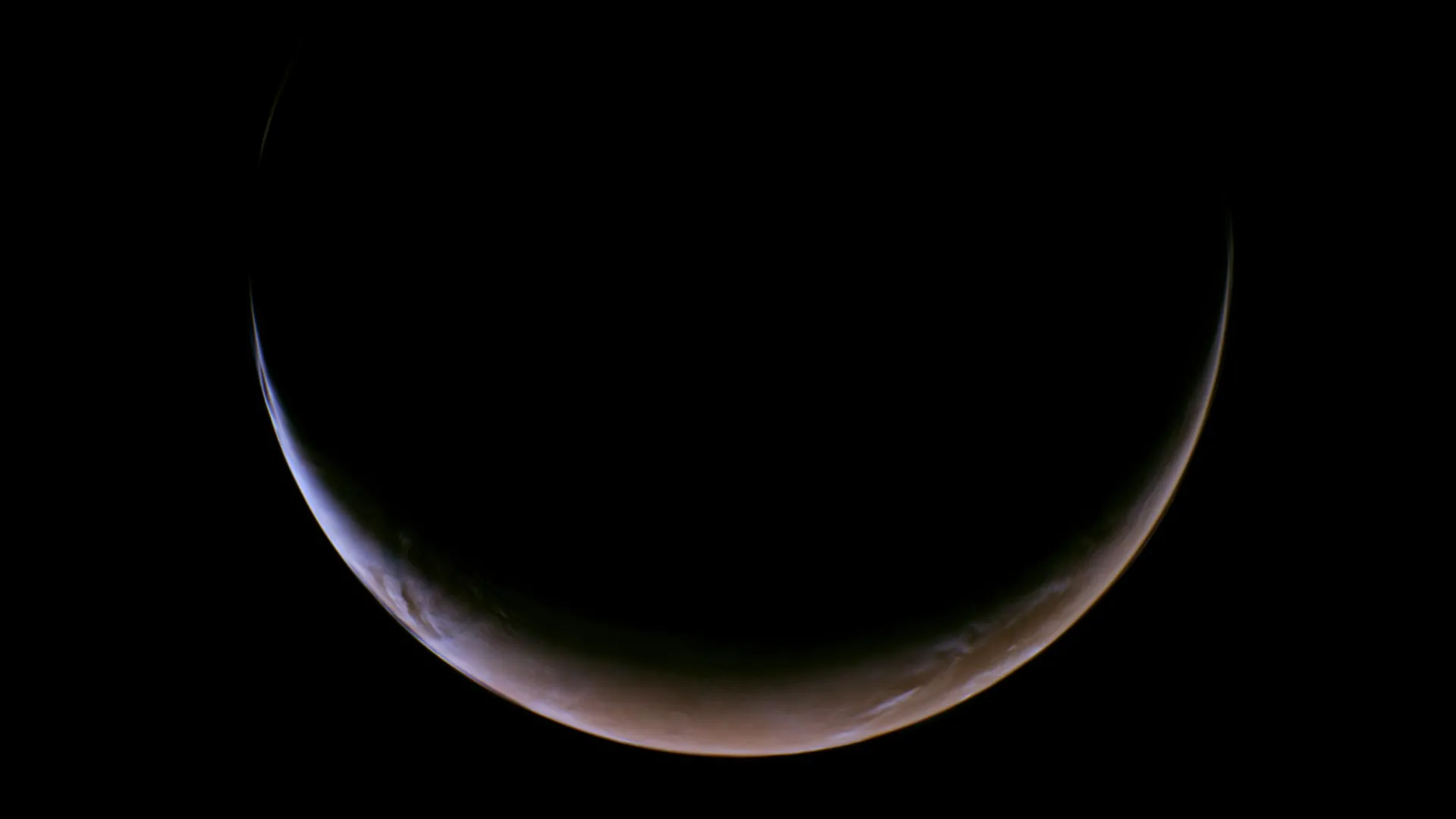
NASA's Psyche spacecraft executed a gravitational assist maneuver at Mars on November 13, 2024, accelerating toward its target asteroid by approximately 1,000 miles per hour. The close flyby leveraged Mars' gravity to redirect the probe's trajectory without expending fuel, a standard but efficient technique for deep space missions.
The spacecraft captured unusual crescent-phase images of Mars during the approach, revealing the planet's dusty atmosphere illuminated against the darkness of space. These images occur when Psyche's camera views Mars at extreme angles, similar to how the Moon appears as a crescent from Earth.
The Psyche mission, developed by NASA's Jet Propulsion Laboratory and Arizona State University, aims to reach the asteroid 16 Psyche in the main asteroid belt between Mars and Jupiter. Scientists believe this metallic world may be the exposed iron core of a protoplanet that lost its rocky mantle during violent collisions billions of years ago. If confirmed, studying 16 Psyche could provide insights into planetary formation and the composition of Earth's own core, which remains inaccessible to direct observation.
The mission launch occurred in October 2023. The spacecraft now continues its trajectory toward the asteroid, which it will reach in 2026. At that point, Psyche will enter orbit around the metallic world and conduct a comprehensive survey using its instruments.
The Mars gravity assist demonstrates a fundamental principle of orbital mechanics: spacecraft can use planetary gravity wells to change velocity and direction economically. This approach has enabled NASA and other space agencies to extend mission ranges and reduce fuel requirements.
The crescent images capture an aesthetic dimension often overlooked in robotic space exploration. They showcase the engineering precision required to navigate the solar system while collecting scientifically valuable data about planetary atmospheres and orbital mechanics. The Psyche mission continues a tradition of NASA using multiple gravitational assists