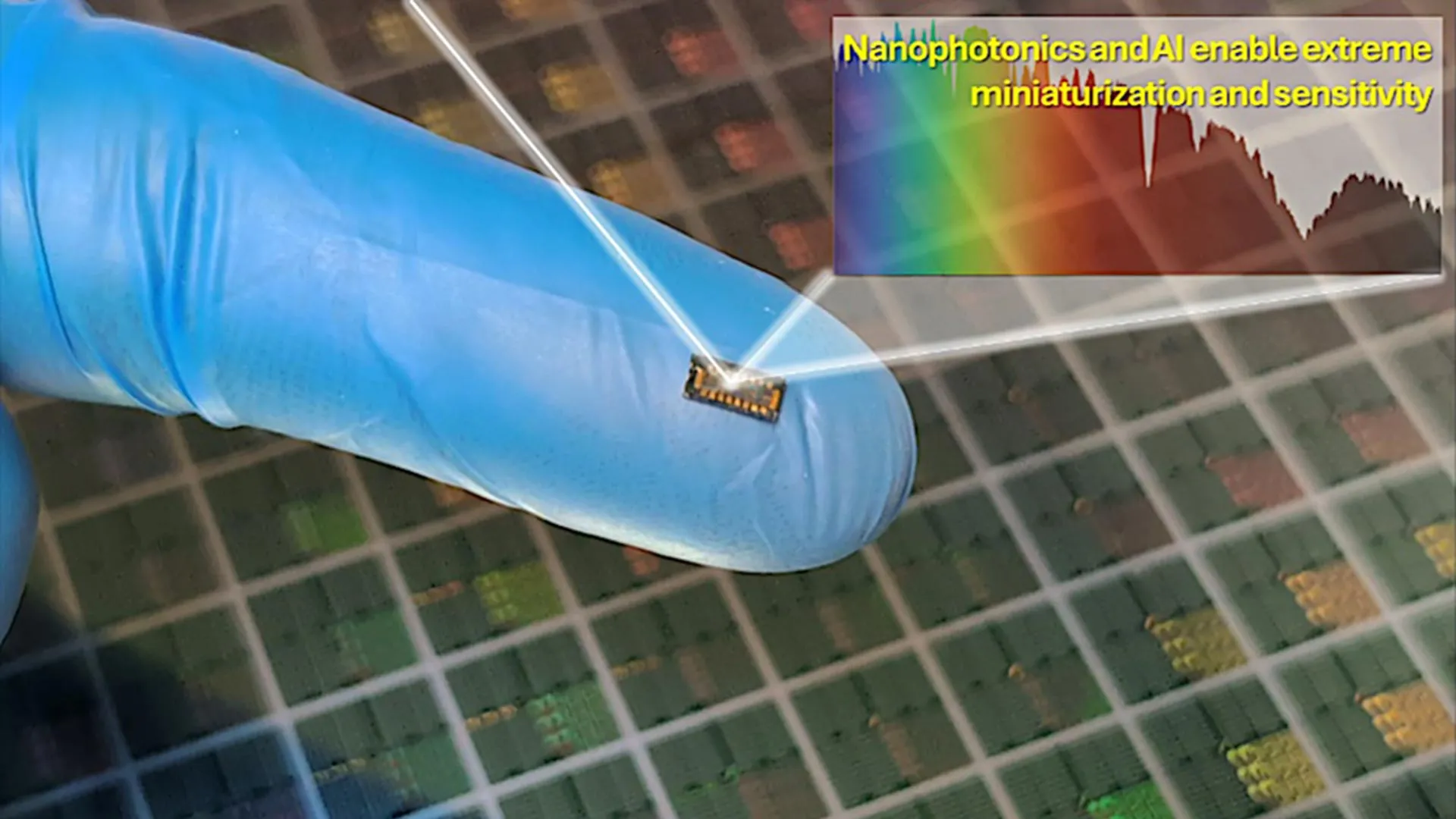
Researchers at UC Davis have developed a miniature spectrometer chip that performs chemical analysis at the scale of a grain of sand. The device combines silicon photonic sensors with artificial intelligence algorithms to identify materials and analyze light composition without requiring traditional laboratory equipment.
The chip works by detecting how different wavelengths of light interact with chemical samples. Rather than using a dispersive optical system like conventional spectrometers, the AI-powered design learns to recognize spectral patterns from training data. This approach eliminates the need for large prisms, gratings, or monochromators that typically occupy significant space in analytical instruments.
The UC Davis team engineered the silicon-based sensor to capture multiple wavelengths simultaneously across a compact footprint. Machine learning algorithms then process these readings to identify specific chemicals and material properties. The researchers trained their neural networks on spectroscopic datasets, enabling the chip to make accurate predictions about sample composition even when relying on fewer discrete wavelengths than traditional instruments would use.
This miniaturization opens practical applications currently impossible with standard lab spectrometers. Environmental monitoring systems could embed the chips into remote sensors for real-time water or air quality analysis. Medical diagnostics could benefit from portable devices for blood analysis or disease detection. Food and agriculture industries could implement quality control in field settings rather than sending samples to centralized laboratories.
The technology's practical range remains bounded by the specific chemicals and materials used to train its AI model. Transfer between different spectroscopic applications requires retraining or careful algorithm adaptation. The chip's accuracy depends on the quality of training data and the complexity of the chemical environment being analyzed. Noisy real-world conditions may challenge performance compared to controlled laboratory settings.
UC Davis researchers plan to expand the chip's capabilities and explore partnerships for commercial development. The work demonstrates how AI and photonic engineering can overcome traditional engineering constraints. Combining machine learning with integrated photonics represents a shift toward intelligent sensing