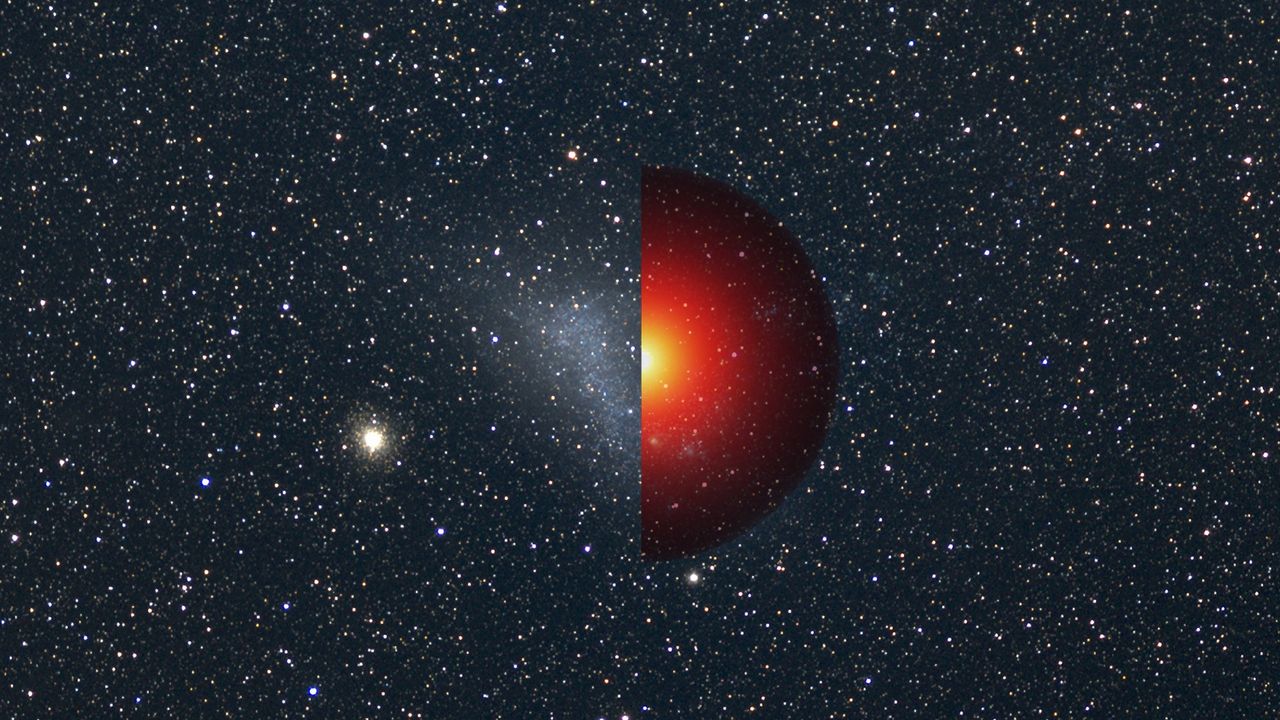
Physicists are exploring whether a cosmic-scale uncertainty principle could account for dark energy without requiring exotic new particles or forces. The concept builds on Werner Heisenberg's quantum uncertainty principle, which states that certain pairs of physical properties cannot be simultaneously known with arbitrary precision.
Researchers propose that the universe itself operates under analogous constraints at large scales. Just as quantum mechanics forbids perfect knowledge of both position and momentum, cosmic uncertainty might limit simultaneous precision in measuring certain universal properties. This framework could explain dark energy, the mysterious force accelerating cosmic expansion, through fundamental uncertainty rather than through dark matter candidates or modifications to general relativity.
The approach offers theoretical elegance. Instead of invoking unknown particles or adjusting Einstein's equations, it suggests dark energy emerges naturally from built-in cosmic limitations on measurement and knowledge. This aligns with a growing trend in theoretical physics that seeks explanations grounded in information theory and fundamental constraints.
However, significant challenges remain. Researchers must demonstrate that a cosmic uncertainty principle produces testable predictions matching observational data about expansion rates and cosmic microwave background properties. Current dark energy models, particularly the cosmological constant framework, already match observations remarkably well, setting a high bar for competing theories.
The work represents speculative theoretical physics rather than confirmed discovery. Moving forward requires rigorous mathematical formulation, numerical predictions, and detailed comparison with existing astronomical datasets. If viable, the framework could unify quantum mechanics and cosmology more deeply, suggesting that uncertainty operates at every scale of physical reality.
This hypothesis exemplifies how physicists address dark energy, one of cosmology's deepest unsolved problems. Rather than accepting dark energy as an unexplained substance, researchers search for mechanisms rooted in fundamental physics. Whether cosmic uncertainty proves viable depends on whether it can generate predictions as accurate as current models while offering greater conceptual unity.