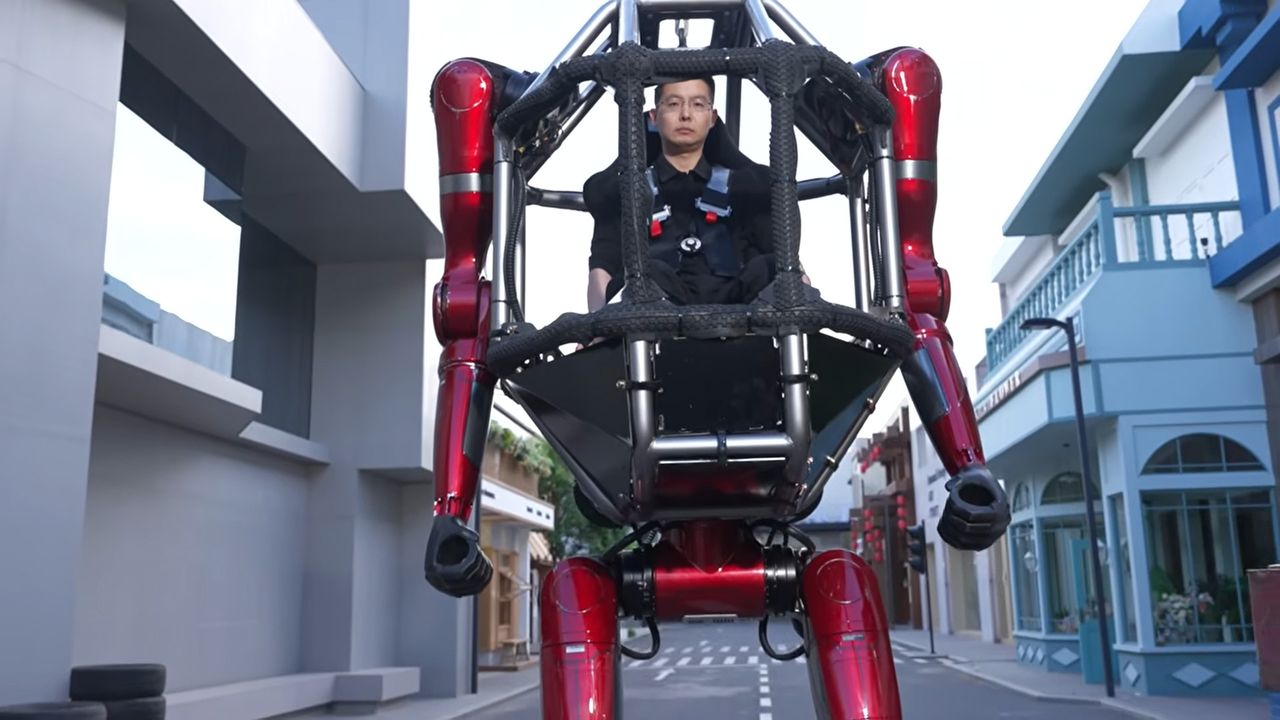
Chinese researchers have unveiled a humanoid robot capable of switching between quadrupedal and bipedal locomotion, functioning as a real-world "transformer" mech. The robot weighs over 1,000 pounds and stands nearly 10 feet tall, engineered specifically for urban mobility applications.
The machine represents a significant engineering achievement in robotics design. By combining two distinct movement modes, the system offers flexibility for navigating diverse urban environments. Quadrupedal movement provides stability and power for traversing obstacles or carrying heavy loads. Bipedal walking enables the robot to navigate human-scaled spaces and interact with infrastructure designed for people.
This dual-locomotion approach addresses a persistent challenge in robotics. Most humanoid robots excel at one form of movement but struggle with transitions. Engineers at the institution developed hydraulic systems and control algorithms that allow smooth switching between the two configurations. The transition itself requires sophisticated weight distribution and joint coordination.
The robot's scale presents both advantages and engineering obstacles. At nearly 10 feet tall, it can see over obstacles and reach high areas. The 1,000-plus-pound weight, however, demands robust materials and powerful actuators. These specifications limit practical applications and require specialized infrastructure for testing and operation.
Urban mobility represents the stated purpose for this development. Researchers envision deployment in rescue operations, infrastructure inspection, or industrial tasks where a machine must navigate sidewalks, stairs, and rubble equally well. The transformation capability theoretically allows one robot to handle multiple scenarios without redesign or specialized variants.
Technical details remain limited in available reports. The researchers have not published comprehensive data on locomotion speeds, energy consumption, or load-carrying capacity for each mode. These metrics matter significantly for assessing practical utility compared to specialized quadrupedal or bipedal alternatives.
The project reflects broader trends in Chinese robotics investment. Government backing and university research partnerships have accelerated development