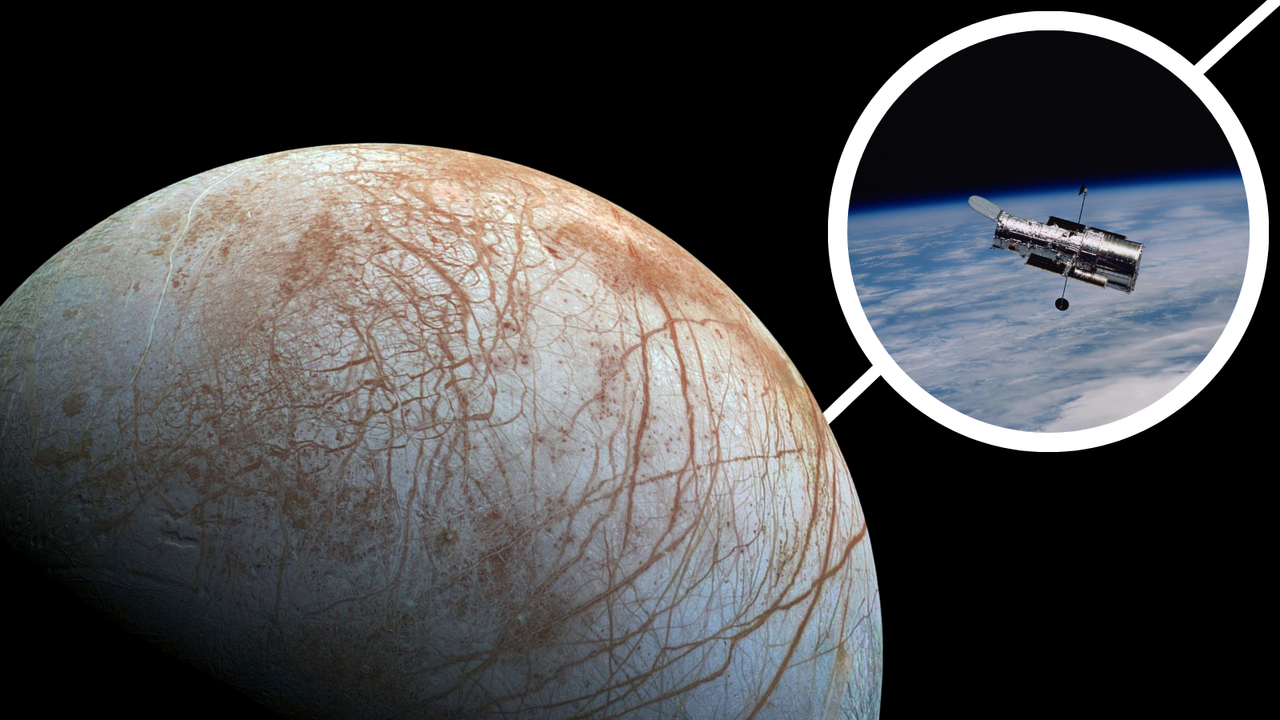
Researchers have substantially weakened their case for water vapor plumes erupting from Jupiter's moon Europa, reversing earlier conclusions based on observations from the Hubble Space Telescope.
The initial detection of these plumes, first reported in 2019 by scientists analyzing Hubble data, suggested that Europa's subsurface ocean was venting into space. This discovery excited researchers because it offered a potential method to study the moon's chemistry without drilling through kilometers of ice. The plumes represented a tantalizing target for future missions seeking biosignatures or evidence of habitability in Europa's hidden ocean.
However, subsequent reanalysis of those same Hubble observations has revealed critical limitations in the original analysis. Scientists examining the data with fresh scrutiny found that the spectroscopic evidence supporting plume detection was considerably weaker than initially reported. The ultraviolet signatures attributed to water vapor plumes proved less distinctive and more difficult to distinguish from background noise than the original researchers acknowledged.
Additional Hubble observations conducted in the years following the initial detection failed to confirm the plumes with consistency. This inconsistency raised questions about whether the original signals represented real phenomena or statistical artifacts produced by processing methods that emphasized faint signals.
The retraction does not eliminate the possibility that Europa produces water plumes. The moon remains geologically active, and its subsurface ocean generates substantial tidal heating that could power such venting. However, the burden of proof has shifted. Future detections will require either clearer spectroscopic signatures or independent confirmation from multiple instruments and observation methods.
This episode underscores the difficulty of detecting faint planetary phenomena from billions of miles away. Hubble, while extraordinarily powerful, observes Europa as a small disk, limiting spatial resolution near the moon's surface. NASA's upcoming Europa Clipper mission, scheduled to conduct detailed investigations beginning in 2024, will provide higher-resolution observations that may finally