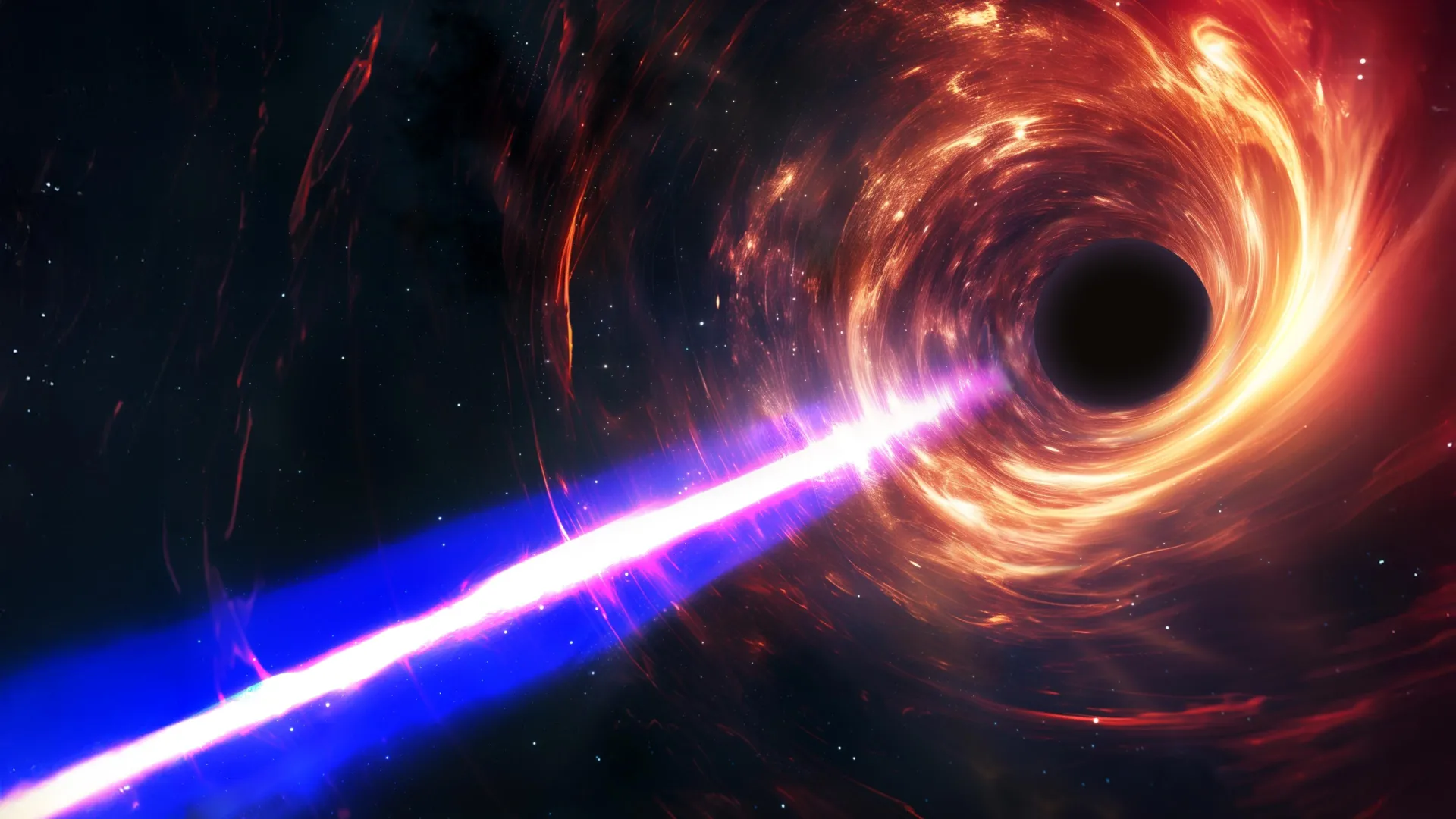
An extraordinarily energetic neutrino detected in the Mediterranean Sea has led researchers to identify blazars as the likely source of these extreme cosmic particles. Blazars are supermassive black holes that emit powerful jets of matter directed toward Earth.
The neutrino represents the most energetic one ever recorded, making the discovery significant for understanding cosmic particle acceleration. Scientists detected the particle using underwater or ice-based detectors sensitive enough to register these rare interactions.
Blazars operate as cosmic accelerators. Material swirling around supermassive black holes gets heated to extreme temperatures and funneled into narrow jets traveling at nearly light speed. When these jets point toward Earth, they become visible and detectable through their radiation across multiple wavelengths. The mechanism that produces these jets also appears capable of accelerating particles like neutrinos to unprecedented energies.
The connection between blazars and ultra-high-energy neutrinos strengthens the case for multi-messenger astronomy. This approach combines observations from traditional telescopes with data from particle detectors, creating a more complete picture of cosmic events. When a blazar produces an exceptionally energetic neutrino, astronomers can cross-check observations and trace the particle back to its source.
This discovery carries implications for fundamental physics. Studying how blazars accelerate particles to such extreme energies tests our understanding of plasma physics and relativity. The neutrino's trajectory and energy provide clues about conditions near supermassive black holes and the strength of magnetic fields in these regions.
However, identifying a single source for one neutrino remains tentative. Neutrinos rarely interact with matter, making them difficult to pinpoint. The researchers likely combined statistical analysis with directional data to establish the connection to a specific blazar. Additional detections would strengthen the evidence and potentially reveal whether blazars consistently produce such high-energy particles or whether this represents a rare event.
Future