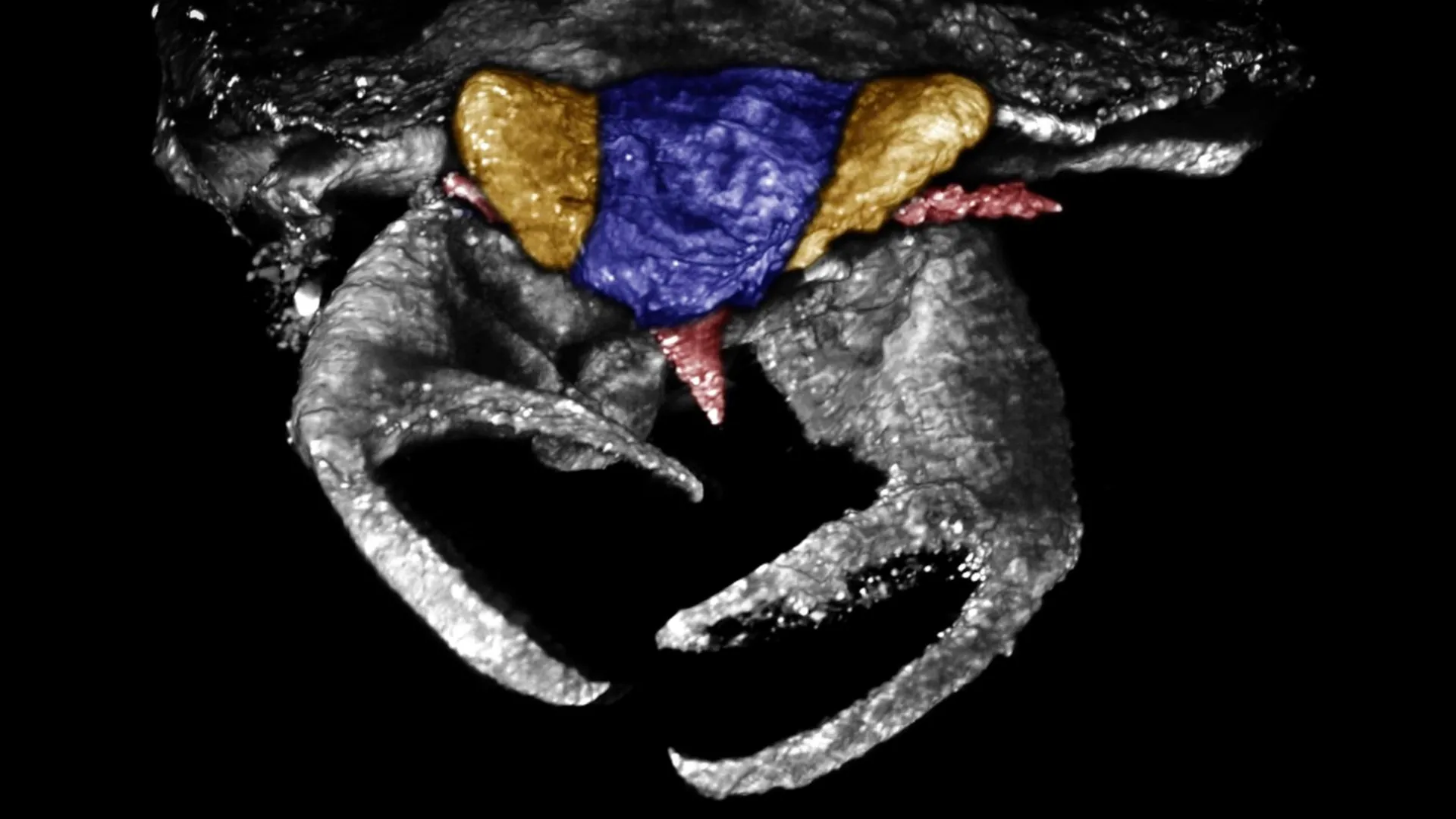
Scientists examining amber from Myanmar have discovered a 100-million-year-old insect with crab-like claws on its front legs, a feature so rare it represents only the fourth known instance of such structures in the entire insect fossil record.
The specimen, preserved in fossilized tree resin, displays prominent chelae—claw-like appendages resembling crab pincers—attached to its front limbs. Researchers determined these structures evolved independently within this particular insect lineage rather than being inherited from a common ancestor. This convergent evolution demonstrates how different organisms can develop similar physical solutions to survival challenges across vast evolutionary timescales.
The discovery adds to an extremely limited roster of insects known to possess chelae. Prior to this finding, only three other insect groups had been documented with such structures, making the Myanmar specimen exceptionally rare in the paleontological record. The specific function of these crab-like claws remains unclear, though scientists typically attribute such appendages to prey capture, defense, or courtship displays in modern arthropods.
Amber preservation offers exceptional advantages for fossil study. The fossilized resin maintains fine anatomical details that rarely survive in standard rock formations, allowing researchers to examine intricate features like the structure and articulation of the ancient insect's claws with remarkable clarity. This preservation quality enables comparative analysis with modern insects and other arthropods.
The 100-million-year-old timeframe places this specimen in the Cretaceous Period, an era when insect diversity exploded and many modern orders were establishing themselves. Understanding how extinct insects adapted to their environments informs current knowledge of arthropod evolution and biomechanics.
The research illustrates how amber fossils continue yielding unexpected discoveries about insect diversity in deep time. Each specimen preserved in these ancient resins provides windows into ecological relationships, behavioral adaptations, and evolutionary pathways that