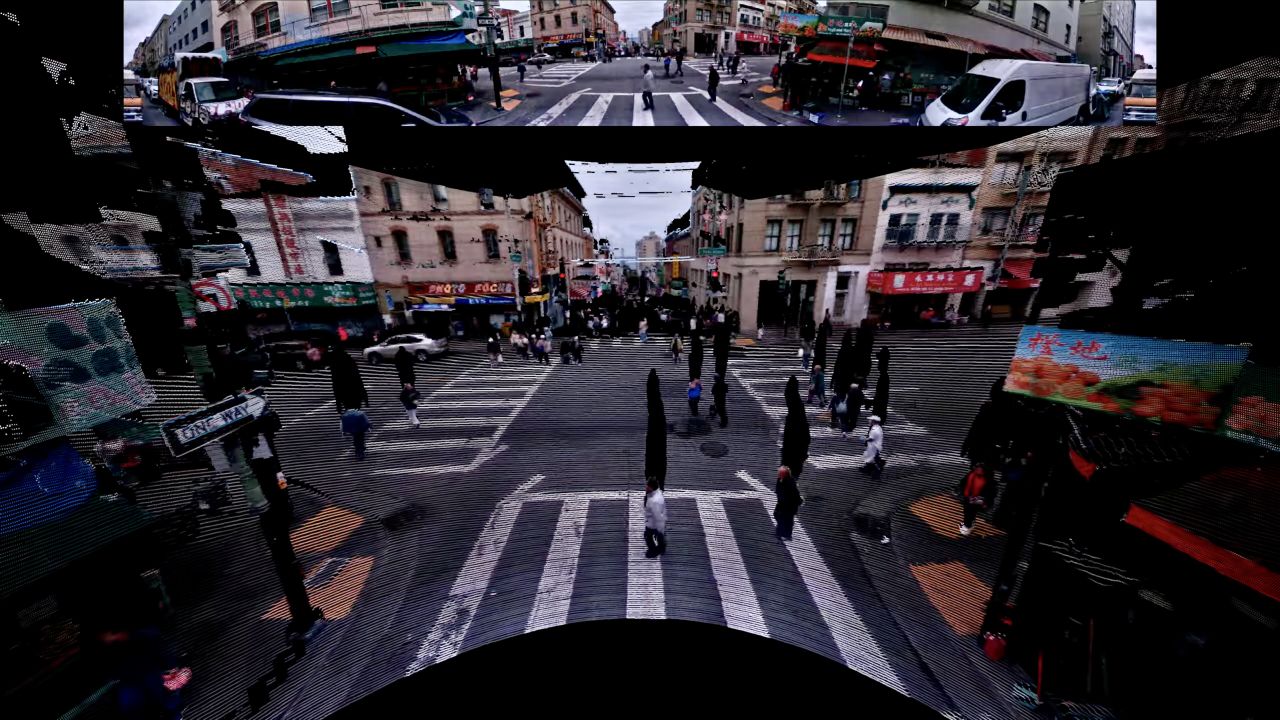
Ouster has unveiled the Rev8, a breakthrough lidar sensor that captures three-dimensional maps while simultaneously recording full-color imagery. The company claims these are the first "native" color lidar devices ever created, combining two sensing functions that have previously required separate hardware.
Traditional lidar systems use laser pulses to measure distance and create 3D point clouds, producing detailed spatial maps but without color information. Cameras add visual data separately, forcing roboticists and autonomous vehicle developers to fuse two distinct sensor streams in software. The Rev8 eliminates this dual-sensor requirement by integrating color capture directly into the lidar's native operation.
The significance lies in hardware simplification and real-time processing gains. Self-driving cars and robots can now obtain both depth and color information from a single device, reducing system complexity, weight, and power consumption. This matters for autonomous vehicles navigating complex urban environments, where distinguishing colored traffic signals, lane markings, and signage from 3D spatial data simultaneously improves safety and decision-making speed.
Ouster's engineering approach represents a technical achievement in sensor design, though the article provides limited detail on the exact methodology. The company has positioned itself as a lidar innovator, competing against established players like Velodyne and emerging rivals in autonomous vehicle sensing.
The implications extend beyond self-driving cars. Robotics, drone mapping, and industrial automation could benefit from integrated color-depth sensing. However, practical performance metrics remain unclear from the announcement. Real-world testing conditions, range capabilities, color accuracy under varying lighting, and cost compared to dual-sensor systems will determine whether this technology achieves mainstream adoption.
The Rev8 launch signals accelerating competition in lidar advancement, driven by the autonomous vehicle industry's growing demands for robust, integrated perception systems.