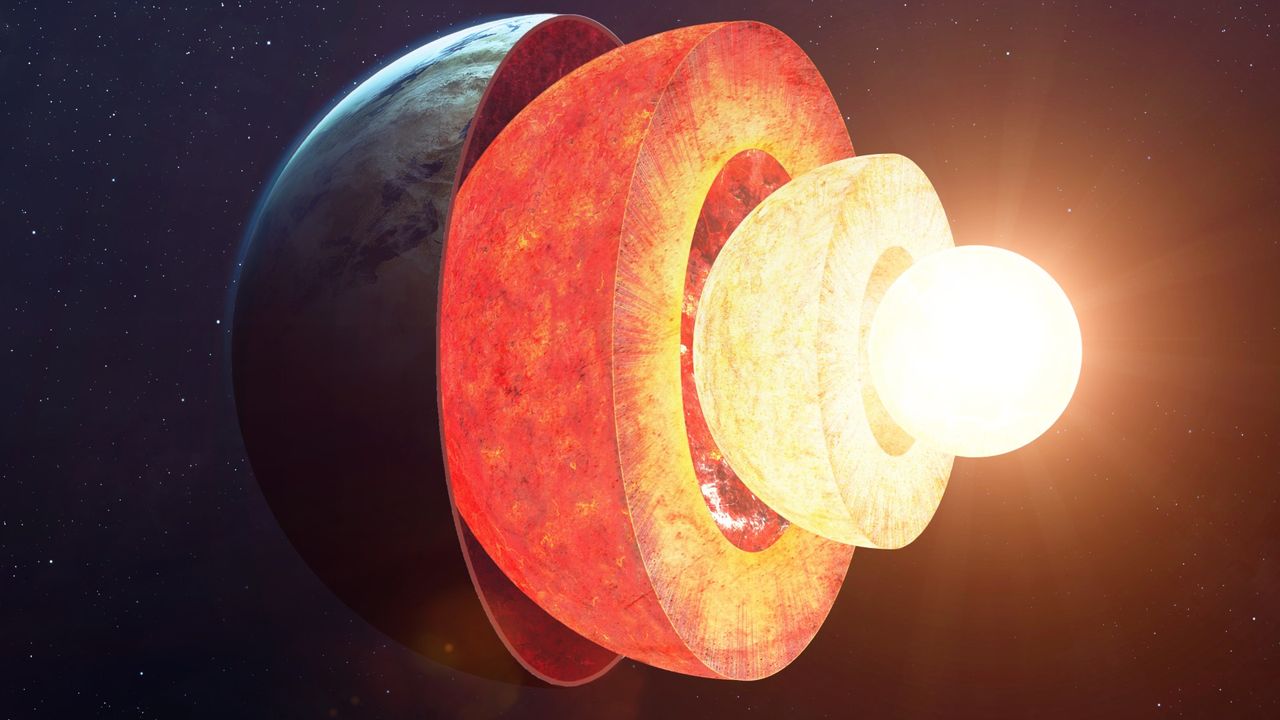
Astronomers have overturned a fundamental assumption about planetary structure. New research suggests that dense metallic cores, long considered a defining feature of terrestrial planets, may be rare among exoplanets across the galaxy.
The finding challenges the Earth-centric model that has guided planetary science for decades. Earth's iron core represents the standard textbook picture of how rocky planets form and organize internally. But evidence now indicates that the most abundant exoplanet type, super-Earths and mini-Neptunes, likely lack substantial metallic cores altogether.
This discovery reshapes understanding of planetary formation. Researchers examining the composition and gravitational signatures of thousands of known exoplanets found that most of them exhibit density patterns inconsistent with large iron cores. Instead, these worlds appear to feature bulk compositions dominated by silicate rock and water or other volatile substances.
The implications extend beyond planetary architecture. A planet's internal structure directly determines its geological activity, magnetic field generation, atmosphere retention, and long-term habitability potential. Planets without metallic cores would experience fundamentally different evolutionary pathways than Earth.
The research emerged from comparative analysis of exoplanet masses and radii, measurements that reveal average density. When scientists applied models incorporating various core sizes and compositions, the data overwhelmingly favored configurations with minimal metallic material. Larger cores simply could not produce the observed density values for the majority of catalogued exoplanets.
This distinction carries profound implications for astrobiology. Magnetic fields, generated by liquid iron cores on Earth, protect planetary atmospheres from stellar wind erosion. Exoplanets lacking these protective barriers would struggle to retain atmospheric compositions necessary for habitability as humans understand it.
The finding also highlights how terrestrial planet formation may represent a relatively unique pathway. Earth's large core likely resulted from specific collision dynamics during the early solar system's chaotic period. Such conditions may be less common