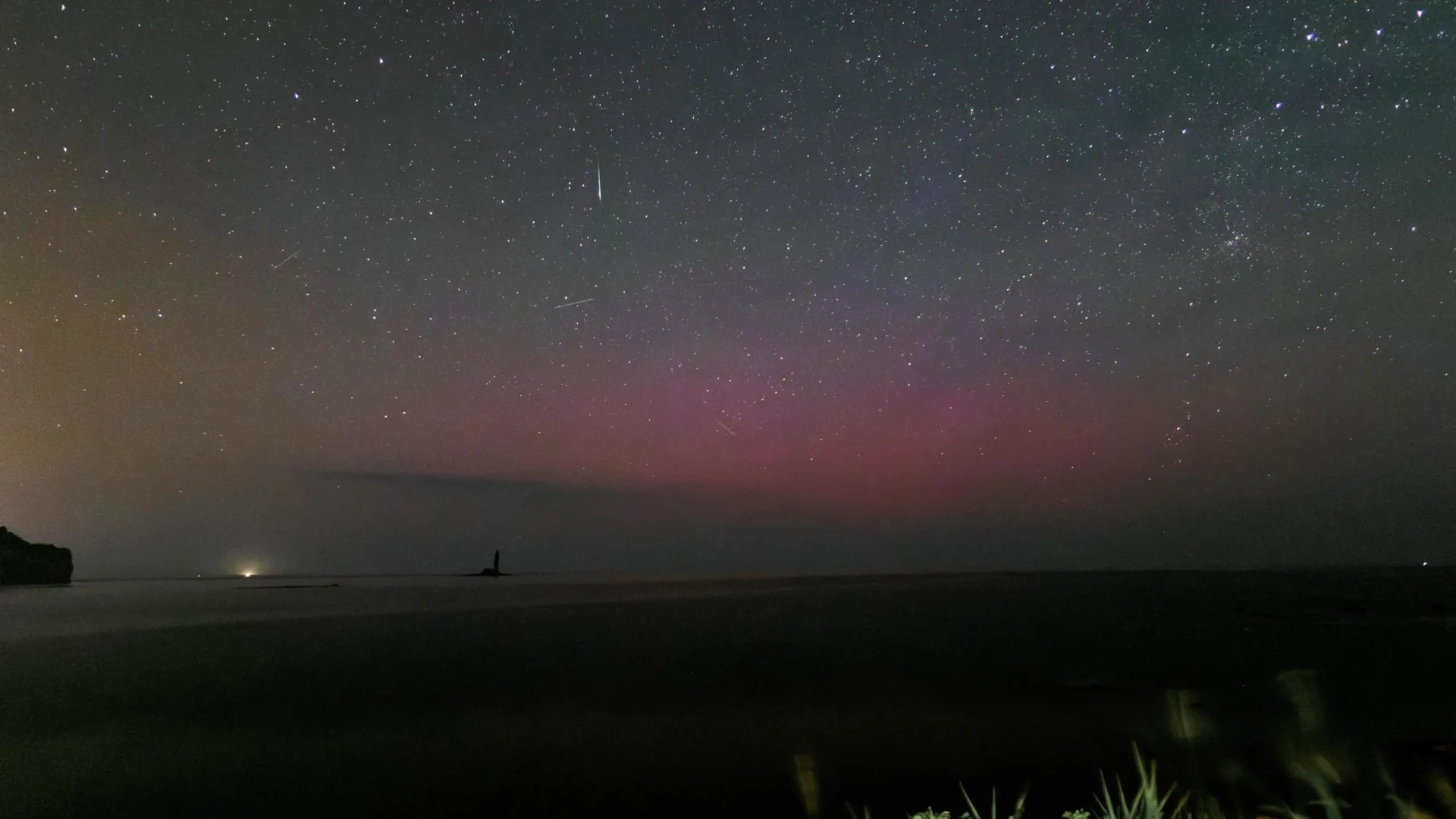
Researchers have identified towering red auroras extending far higher into space than previously documented, challenging conventional understanding of how solar storms energize Earth's upper atmosphere. The phenomenon occurred above Japan during geomagnetic storms of moderate intensity, suggesting that atmospheric dynamics during these events operate more powerfully than current models predict.
Red auroras, or "red sprites," typically form when charged particles from the sun interact with oxygen molecules in the thermosphere at altitudes exceeding 300 kilometers. Scientists expected such displays only during severe geomagnetic disturbances. The detection of these structures during relatively mild space weather events indicates that either atmospheric conditions amplify solar energy more efficiently than thought, or solar particle streams carry greater energy than instruments currently measure.
The research team used ground-based and satellite observations to track the auroras' vertical extent. The exact institution and lead researcher names were not disclosed in the available information, though the work appears published through peer-reviewed channels. The findings raise questions about satellite vulnerability during even modest geomagnetic activity, as high-altitude phenomena can influence the ionosphere where numerous communications and navigation satellites operate.
Understanding these red auroras matters for space weather prediction. Satellites in low Earth orbit experience increased drag when atmospheric density rises at their altitude, potentially shortening operational lifespans or requiring costly maneuvers to maintain position. GPS systems, radio communications, and power grids all depend on satellites operating reliably during space storms.
The discovery points to gaps in current solar-terrestrial physics models. If red auroras reach unexpectedly high altitudes during mild storms, forecasters may have underestimated the ionosphere's sensitivity to solar input. Future research will likely focus on the mechanisms driving these tall red auroras and whether they appear globally or remain concentrated in specific regions like Japan.
This work underscores why continuous monitoring of Earth's upper atmosphere remains essential as human infrastructure increasingly depends on space-based systems.