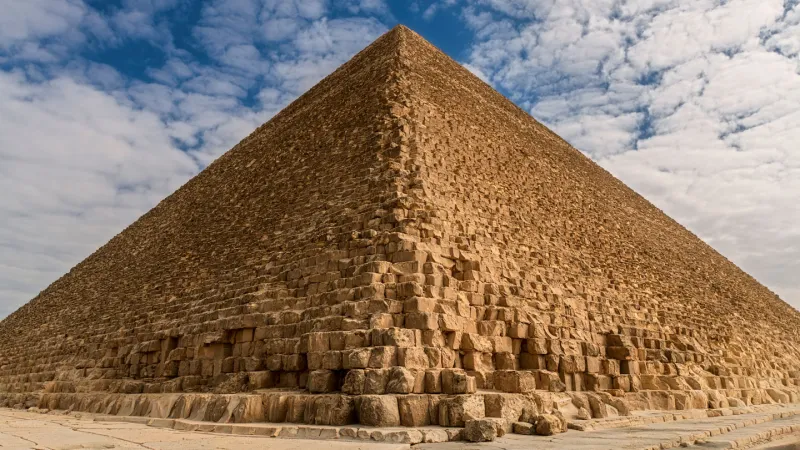
Engineers studying the Great Pyramid of Giza have identified why this 4,500-year-old structure has survived thousands of earthquakes largely intact. The answer lies in a mismatch between how the pyramid vibrates and how the surrounding soil moves during seismic activity.
Researchers discovered that the pyramid's massive limestone blocks vibrate at different frequencies than the bedrock beneath it. This frequency mismatch acts as a natural shock absorber, preventing resonance that would amplify earthquake damage. When structures vibrate at the same frequency as seismic waves, the oscillations compound, causing catastrophic failure. The pyramid avoids this trap.
The design of the pyramid amplifies this protective effect. Its sloped sides and internal ramp systems distribute seismic forces differently than a rectangular structure would. The stepped internal architecture also prevents stress from concentrating in vulnerable zones. These features were likely intentional, though ancient builders probably didn't understand the physics by modern terms. They built empirically, learning what worked through observation across generations.
The soil composition surrounding the pyramid matters too. The combination of stone blocks, sand layers, and clay acts as a damping system that dissipates seismic energy before it reaches the structure. This natural foundation engineering created redundancy against ground motion.
The research documents why the Great Pyramid outperformed other ancient Egyptian monuments that experienced more damage from earthquakes. Temples and other structures built with different proportions and materials failed more frequently. The pyramid's exceptional durability reflects both lucky geology and sophisticated architectural decisions made millennia ago.
Engineers now apply these principles to modern earthquake-resistant design. Understanding how mass distribution, material frequency response, and soil-structure interaction work together informs contemporary construction in seismic zones. The Great Pyramid remains an unintentional masterclass in resilient engineering, its survival teaching lessons to scientists designing buildings for the 21st century.
CATEGORY