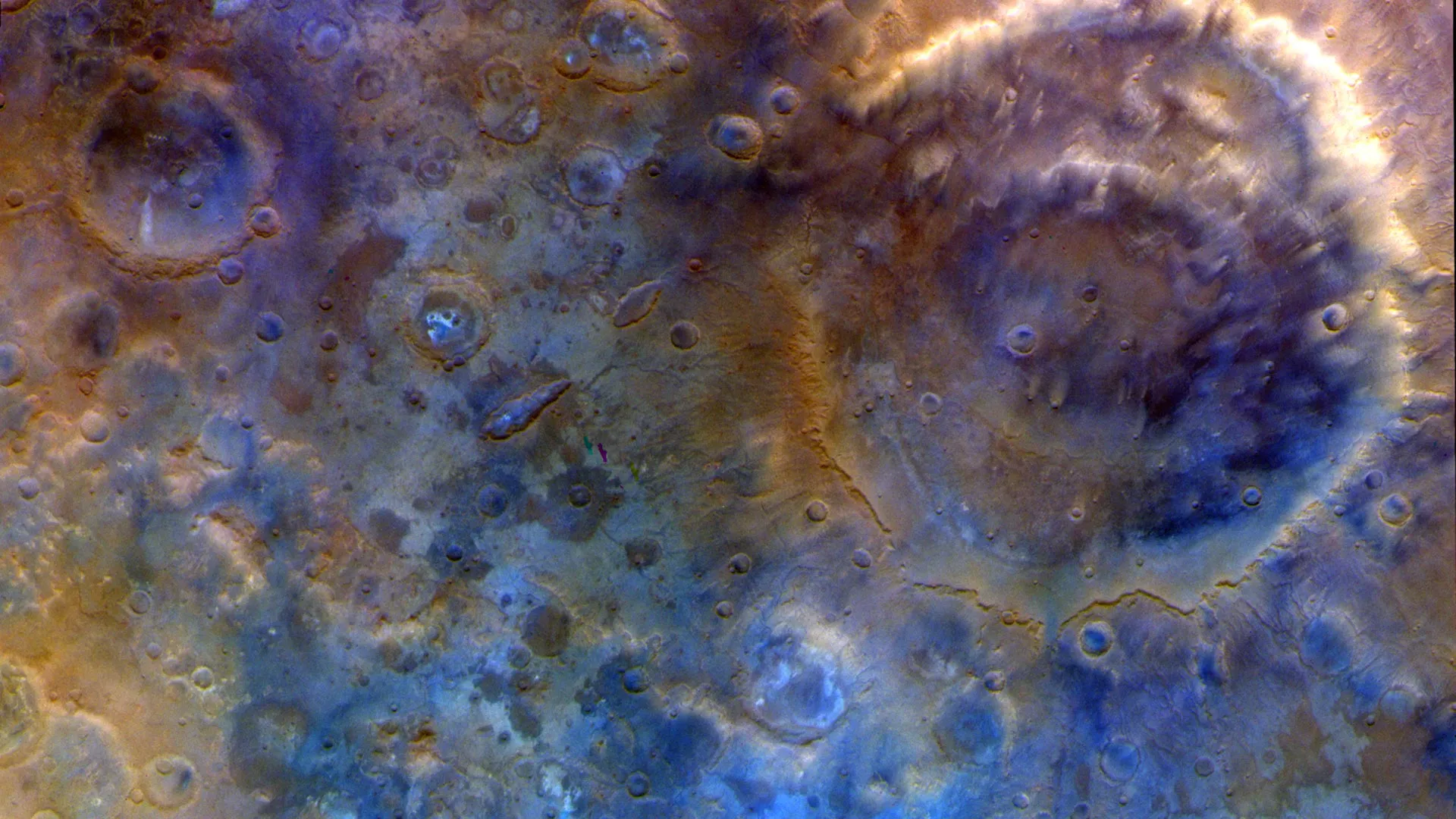
NASA's Psyche spacecraft executed a high-speed gravity-assist maneuver past Mars on its journey to an unusual metal-rich asteroid. The spacecraft captured high-resolution images of the Martian surface during the flyby, including detailed views of heavily cratered terrain and the distinctive double-ring Huygens crater.
The maneuver served a dual purpose. The gravity assist used Mars's gravitational pull to accelerate the spacecraft deeper into space without consuming additional fuel, a standard technique for extending mission range and efficiency. Simultaneously, the imaging provided valuable data about Martian geology while demonstrating the Psyche spacecraft's camera systems during operational flight.
Psyche, the mission's ultimate destination, represents one of NASA's most intriguing targets. Located in the asteroid belt between Mars and Jupiter, the asteroid Psyche appears unusually dense and metal-rich, containing significant quantities of iron and nickel. Scientists theorize it may be the exposed iron core of a protoplanet, offering a rare window into planetary formation processes that occurred billions of years ago. Direct study of such a metal-rich body could illuminate how rocky planets develop their cores.
The spacecraft's design reflects this ambitious goal. Built by Arizona State University and managed by NASA's Jet Propulsion Laboratory, Psyche carries instruments specifically calibrated to analyze the asteroid's composition, magnetic properties, and structure upon arrival in late 2029.
This Mars encounter marks one of several intermediate milestones for the mission. Gravity-assist flybys remain essential tools in deep-space exploration, allowing spacecraft to reach distant targets while operating within strict fuel constraints. The detailed images captured during the pass also serve practical purposes, enabling mission teams to validate instrument performance and refine navigation procedures.
The Psyche mission exemplifies modern planetary science strategy, combining fuel efficiency with scientific observation. The images and data gathered during this Mars encounter contribute to broader