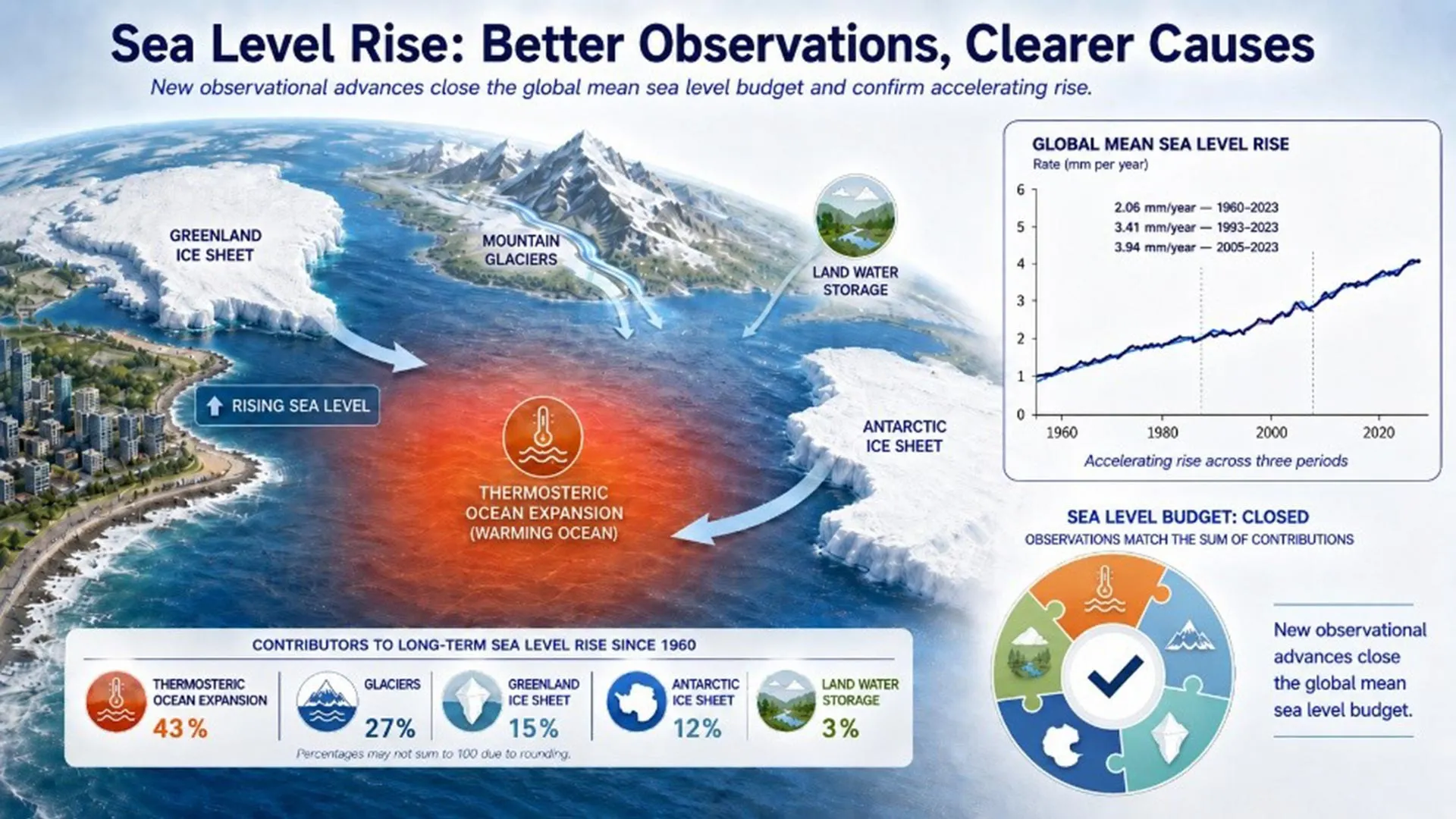
Scientists have identified the precise mechanisms accelerating sea level rise, resolving a long-standing discrepancy in ocean measurements. The research reveals that thermal expansion of warming seawater accounts for the largest contribution, while accelerating ice melt from glaciers and polar ice sheets adds an increasing volume of water annually.
The acceleration matters because current rates substantially exceed historical trends. Global sea levels rose roughly 1.4 millimeters per year in the early 1990s but now rise at approximately 4.5 millimeters annually. This threefold increase threatens coastal cities, agricultural zones, and island nations with flooding and saltwater intrusion into freshwater aquifers.
Warming ocean water expands physically as temperatures climb, a process called thermal expansion. This thermal effect currently drives roughly half of observed sea level rise. The remaining portion comes from melting land ice. Greenland's ice sheet loses roughly 280 billion tons of ice yearly, while Antarctica sheds approximately 150 billion tons annually. Mountain glaciers contribute additional meltwater globally.
The research resolves what oceanographers call the "20th century sea level budget puzzle." For years, the sum of measured contributors—thermal expansion and ice melt—fell short of observed sea level rise by a meaningful margin. Scientists lacked a satisfactory explanation for the gap. Recent advances in satellite measurements and improved ice sheet monitoring finally closed this discrepancy, allowing researchers to account for virtually all observed rise.
This breakthrough clarifies climate physics and strengthens confidence in future sea level projections. Climate models now produce estimates that align with observed acceleration patterns. Scientists project sea levels will rise another 1 to 4 feet by 2100, depending on greenhouse gas emissions trajectories.
The findings underscore how ocean warming and ice loss operate together as interconnected climate forcings. Reducing both requires cutting carbon emissions, which slows ocean warming, and protecting