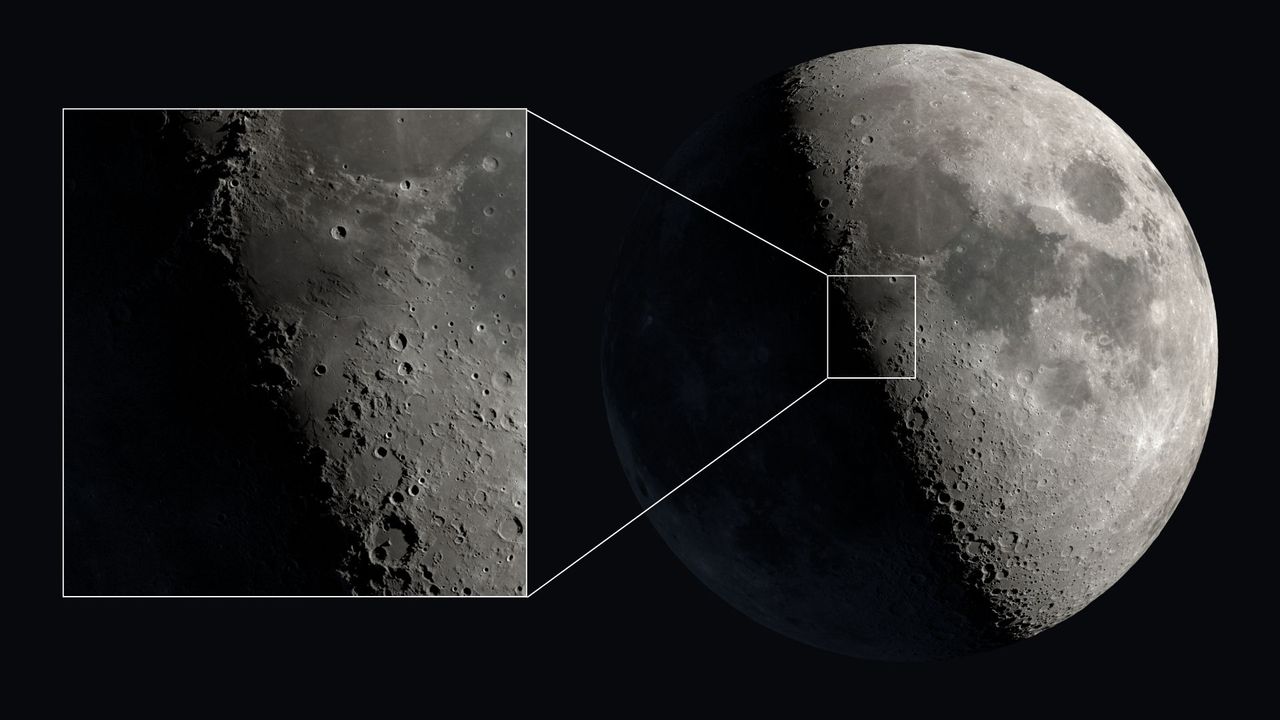
A pair of distinctive X and V shapes will become visible on the moon's surface during May's first quarter phase, offering skywatchers an accessible target for observation.
These lunar features form naturally through the interplay of sunlight and shadow across the moon's cratered terrain. As the sun illuminates the lunar surface at a specific angle during the first quarter phase, the topography creates these letter-like patterns. The X shape typically forms from the intersection of ridge systems and crater walls, while the V shape emerges from similar shadow-casting formations.
The first quarter moon occurs when the lunar disk appears half-lit from Earth's perspective, roughly seven days after the new moon. During this phase, the terminator line separating day from night on the lunar surface moves across distinct geographic features, casting shadows that accentuate certain formations over others.
Observing these patterns requires minimal equipment. Binoculars or a basic telescope reveal the shapes more clearly than naked-eye viewing, though the moon remains easily visible without optical aid. The best viewing window occurs during evening hours after sunset, when the moon reaches sufficient altitude in the sky for comfortable observation.
The exact timing and visibility depend on location and weather conditions. Clear skies free from cloud cover prove essential for optimal viewing. Those in urban areas with light pollution may still observe the moon, as its brightness typically overwhelms ambient light.
These lunar letter formations appear regularly during the first quarter phase as the moon's rotation and Earth's orbital position create consistent geometric alignments. Amateur astronomers often use such features as navigation aids when mapping the lunar surface or identifying specific craters and mountain ranges.
The observation requires no specialized knowledge or advanced equipment, making it an accessible activity for families and casual observers interested in lunar geography. The visual effect disappears as the moon progresses toward full phase, since the changing sun angle eliminates the shadow contrasts that create the distinctive shapes.