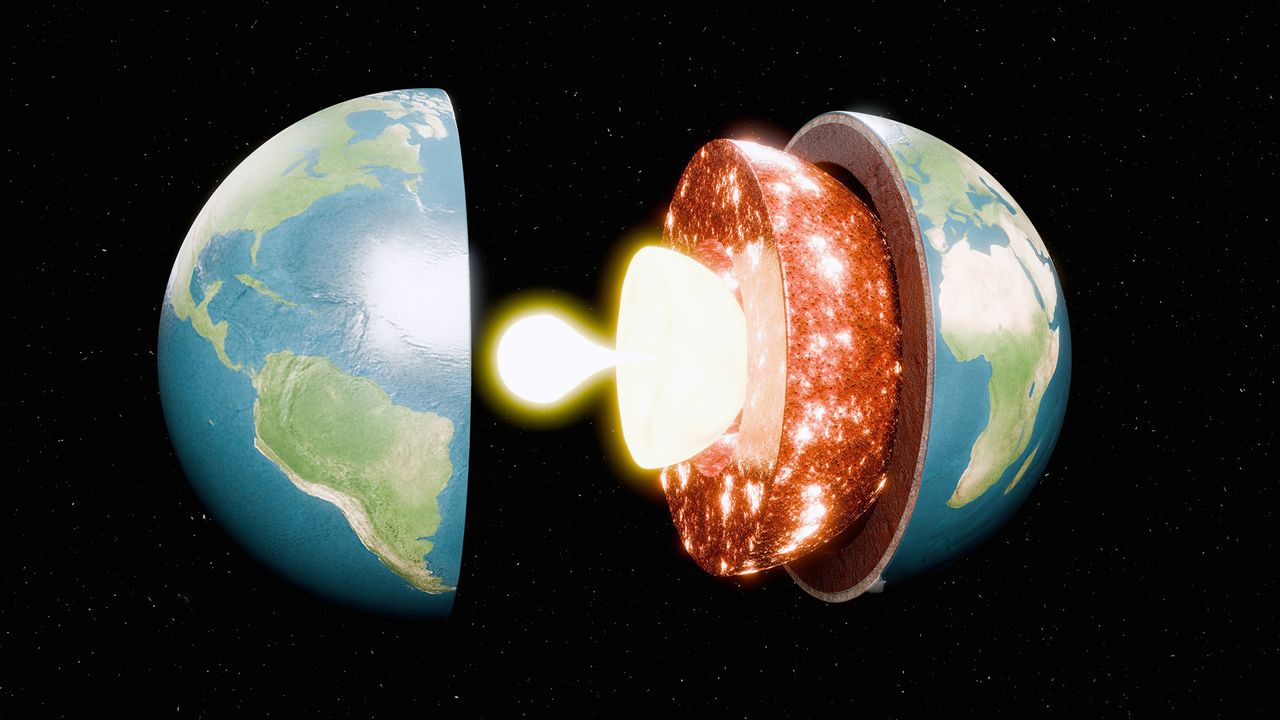
Scientists estimate Earth's inner core reaches temperatures around 9,200 to 10,000 Kelvin, roughly matching the surface of the sun. Researchers determine this through a combination of seismic wave analysis, laboratory experiments, and computer modeling.
Seismic waves from earthquakes travel through Earth's layers at different speeds depending on the material and temperature they encounter. By mapping these waves globally, seismologists construct detailed models of the planet's interior structure. The waves slow down in hotter regions, allowing scientists to infer temperature gradients.
Laboratory experiments provide crucial validation. Researchers compress iron and other core materials using diamond anvil cells, subjecting them to the extreme pressures found thousands of kilometers below the surface. These conditions replicate the core environment, allowing direct measurement of how materials behave under such stress. Scientists then compare the properties of compressed samples to seismic observations, narrowing temperature estimates.
Computer simulations integrate all this data. Models incorporate known physics of material behavior, pressure conditions at various depths, and heat flow from radioactive decay of elements like uranium and thorium within the core. These simulations generate temperature profiles that match seismic observations when core temperatures reach approximately 9,500 Kelvin.
The outer core, which remains liquid, reaches around 4,000 to 9,000 Kelvin. This temperature difference drives convection currents in molten iron that generate Earth's magnetic field, protecting the planet from solar radiation.
Recent refinements in experimental techniques have improved accuracy. Work published in journals focused on geophysics continues to test these boundaries. Scientists acknowledge uncertainties remain. The exact composition of the inner core, precise pressure measurements at extreme depths, and heat transport mechanisms all introduce potential error margins of several hundred degrees.
Understanding core temperature matters for planetary science. It informs models of how Earth formed, how the planet cools over geologic time,