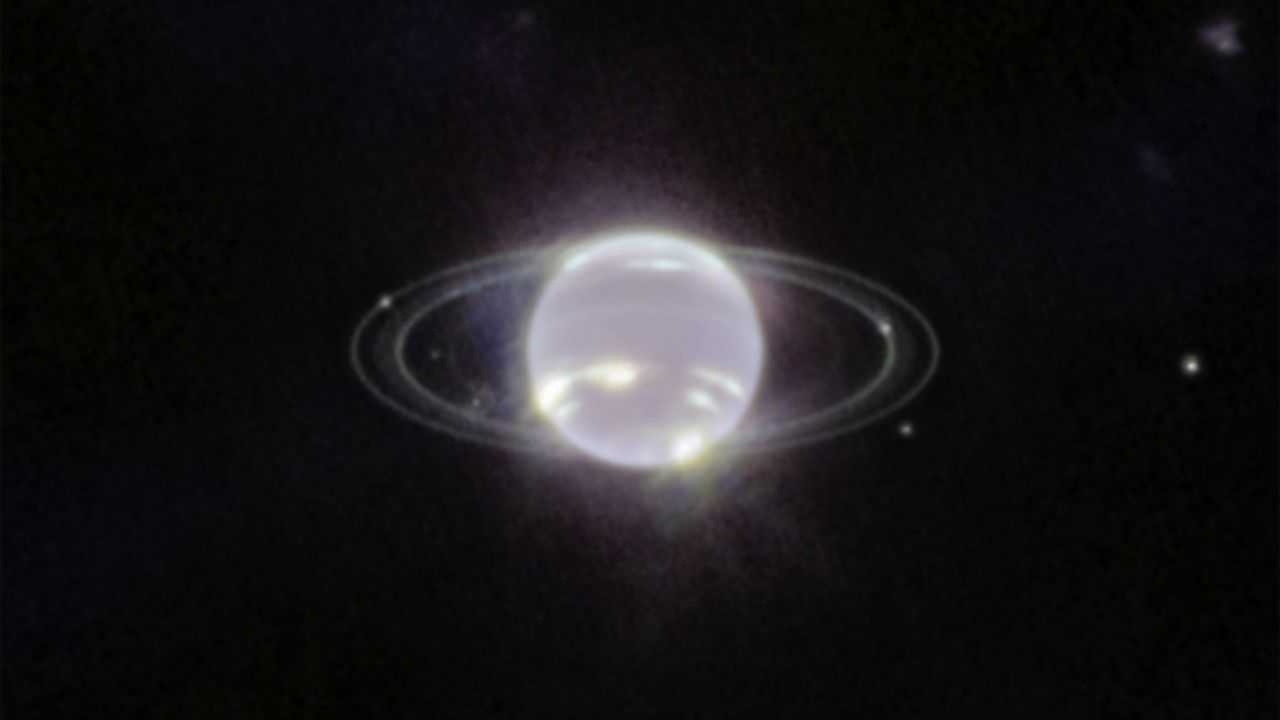
Researchers have proposed that Neptune's enigmatic moon Nereid may represent the sole survivor of the planet's original satellite system, according to a new study. The discovery reshapes understanding of Neptune's violent orbital history.
Nereid orbits Neptune in an unusual pattern. The moon travels in a highly elliptical, retrograde orbit at extreme distances from the planet, making it distinct from Neptune's other known moons. This peculiar trajectory has puzzled astronomers for decades.
The research suggests that Neptune's current moon system formed after a catastrophic rearrangement of the outer solar system. During the giant planet migration period, roughly 4.5 billion years ago, gravitational interactions between Jupiter, Saturn, Uranus, and Neptune destabilized their positions. This chaos likely destroyed most of Neptune's original moons through collisions or ejection into space.
Nereid's extreme orbital characteristics offer clues about how it survived. Its distant, retrograde path placed it far from the destruction zone during the solar system's violent reorganization. While Neptune's other moons, including the larger Triton, were either captured later or formed after the chaos subsided, Nereid persisted in its unusual orbit from the system's earliest days.
The study connects Nereid's peculiar motion to computer simulations of planetary migration models. These models show that objects on highly eccentric, distant orbits had better odds of remaining intact when the giant planets shuffled positions. Nereid's survival tells a story written in orbital mechanics.
This work advances researchers' understanding of moon formation and planetary migration. It demonstrates that unusual orbital properties can reveal a moon's age and origin story. Nereid, long considered an oddity among Neptune's satellites, now appears to be a precious relic of the solar system's chaotic youth. Future observations and potential missions to Neptune could test these predictions and reveal more about how the outer