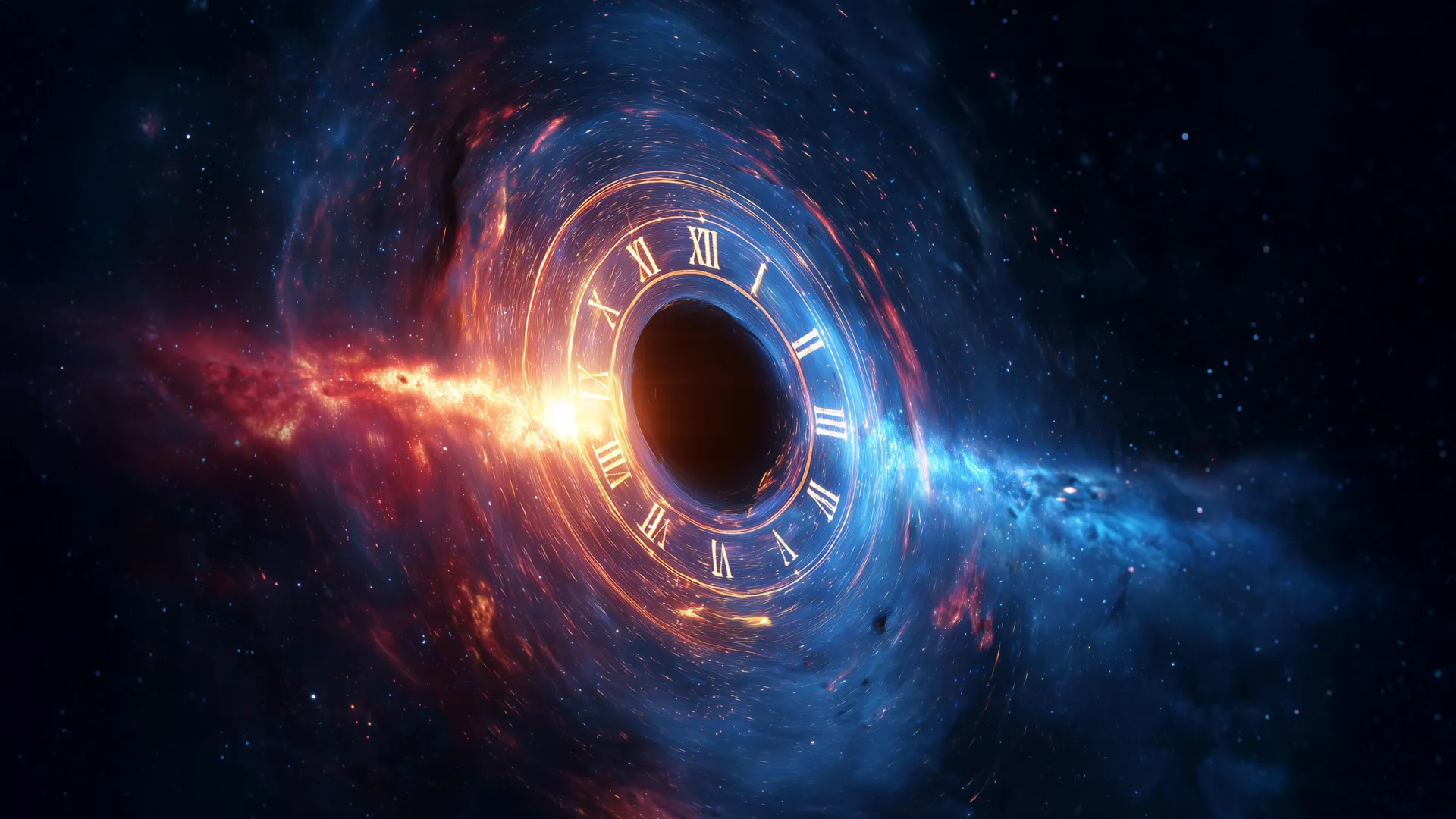
Researchers propose a radical reinterpretation of the Einstein-Rosen bridge, the theoretical structure physicists have long imagined as tunnels through spacetime. Rather than portals connecting distant regions of the universe, the bridge may function as a gateway between two opposing directions of time, according to emerging theoretical work.
The new framework addresses the black hole information paradox, a decades-old problem that has troubled physicists. When matter falls into a black hole, classical physics suggests information vanishes permanently. However, quantum mechanics insists information cannot be destroyed. This contradiction has resisted resolution for over forty years.
The proposal suggests that information entering a black hole does not disappear but instead flows backward through time into a mirror universe or alternate temporal configuration. This would preserve quantum information while maintaining consistency with both general relativity and quantum mechanics. The mechanism operates at subatomic scales where quantum effects dominate, potentially reconciling two fundamental theories that normally refuse to coexist.
The implications extend further. If time can flow bidirectionally within these quantum structures, the framework hints that spacetime may possess a more complex temporal architecture than conventional models allow. Some interpretations suggest the universe could have existed in some form before the Big Bang, challenging standard cosmological assumptions.
The research remains speculative and highly theoretical. No experimental evidence currently supports these concepts, and the mathematics requires rigorous peer review before gaining acceptance. The work sits at the frontier of quantum gravity research, where physicists attempt to merge quantum mechanics with Einstein's general relativity, a task that has eluded successful resolution.
These ideas emerge from ongoing efforts to understand black hole thermodynamics and the fundamental nature of information at quantum scales. While the specific claim about bidirectional time remains controversial, the research illustrates how contemporary physics continues interrogating Einstein's predictions in unexpected directions, potentially revealing hidden structures within reality itself.