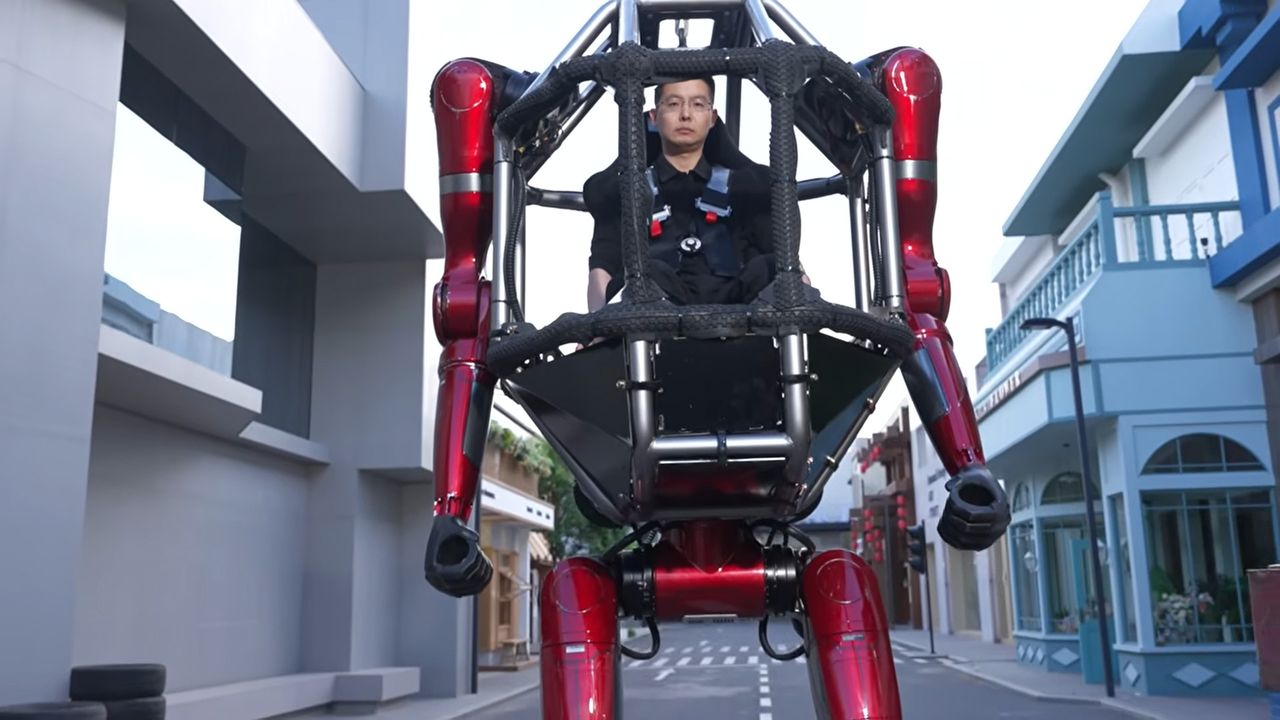
China has unveiled a large humanoid robot capable of shifting between quadrupedal and bipedal locomotion, a capability researchers say enables more efficient navigation through urban environments. The machine, built by a Chinese robotics team, weighs more than 1,000 pounds and stands nearly 10 feet tall.
The robot's dual-mode locomotion system represents a practical engineering solution to a persistent challenge in legged robotics. Quadrupedal movement provides stability and energy efficiency at higher speeds, while bipedal walking allows the robot to navigate obstacles and terrain designed for human passage. By switching between these modes, the machine can optimize its energy consumption based on environmental demands.
The researchers designed the system for urban mobility applications, suggesting potential deployment in disaster response, search and rescue operations, or infrastructure inspection tasks. A robot that can traverse varied terrain while maintaining the humanoid form factor offers operational flexibility that single-mode systems cannot match. The ability to walk on two legs gives the machine access to human-scale spaces, while the four-legged configuration provides the stability needed for rapid movement across open ground.
This development builds on existing research in biomimetic robotics, which draws inspiration from animal locomotion to improve machine performance. The quadrupedal-to-bipedal transition itself presents engineering challenges involving real-time weight distribution, joint articulation, and dynamic balancing. How the Chinese team addressed these mechanical and computational hurdles remains unclear from available details.
The robot joins a growing field of sophisticated humanoid platforms. Boston Dynamics has pioneered bipedal robots, while numerous teams have developed quadrupedal machines. Few robots achieve seamless switching between these modes, making this design noteworthy for roboticists.
Questions remain about practical deployment timelines, operational costs, and real-world performance across diverse urban settings. The specifications also do not clarify whether the robot operates autonomously or requires teleoperation