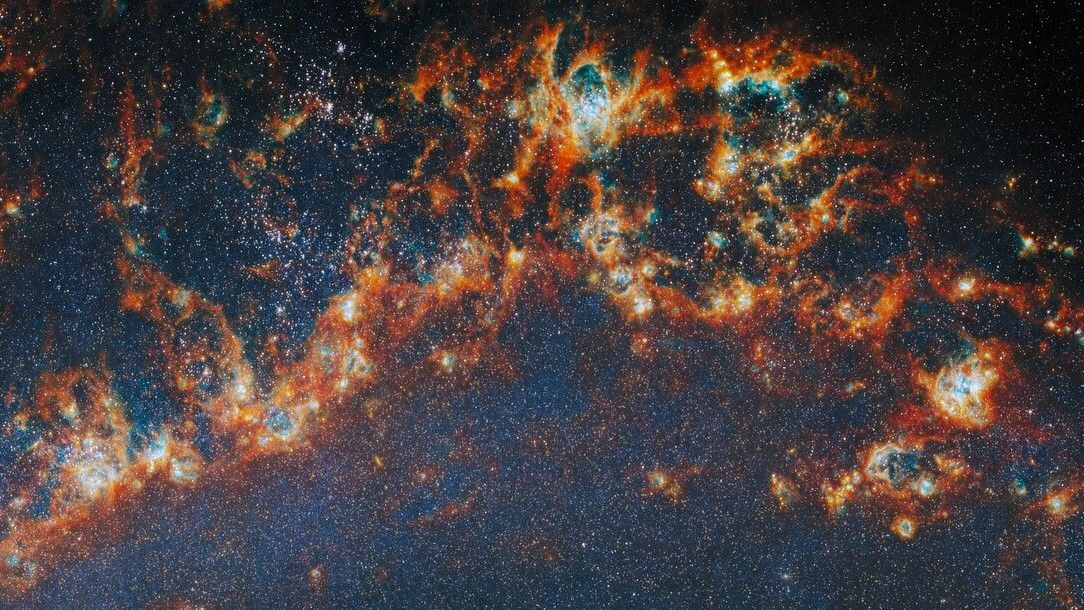
The James Webb Space Telescope and the Hubble Space Telescope have combined their observations to produce a detailed image of the Whirlpool Galaxy (Messier 51), located roughly 23 million light-years from Earth. This composite photograph reveals intricate details of the galaxy's spiral arms and dust lanes with unprecedented clarity.
Astronomers are using the new imagery to investigate fundamental questions about how stars form in galaxies. The Whirlpool Galaxy serves as an ideal laboratory for this research because its face-on orientation allows scientists to observe its structure directly without viewing angle distortion.
Webb's infrared capabilities penetrate dust clouds that obscure visible light, exposing regions where new stars are actively forming. Hubble's visible-light observations complement Webb's data by capturing older stellar populations and providing wavelength coverage across the electromagnetic spectrum. Together, the telescopes reveal how gas flows through the galaxy's spiral structure and how this motion triggers star formation.
The image highlights the dramatic interaction between the Whirlpool Galaxy and its smaller companion galaxy, NGC 5195. Gravitational forces between the two systems shape the Whirlpool's iconic spiral pattern and influence where and when stars ignite within its disk.
Understanding star formation across different galactic environments remains a central challenge in astronomy. The Whirlpool Galaxy's proximity and favorable geometry make it a benchmark system for testing theories about how density waves in spiral arms compress gas and initiate stellar nurseries. This knowledge applies broadly to understanding star formation throughout the universe.
The coordinated use of Webb and Hubble exemplifies modern observational astronomy's power. Neither telescope alone could provide the complete picture that their combined data yields. Webb launched in 2021 with infrared sensitivity that revolutionized observations of dust-shrouded regions, while Hubble, operating since 1990, continues delivering crucial visible-light context. Such