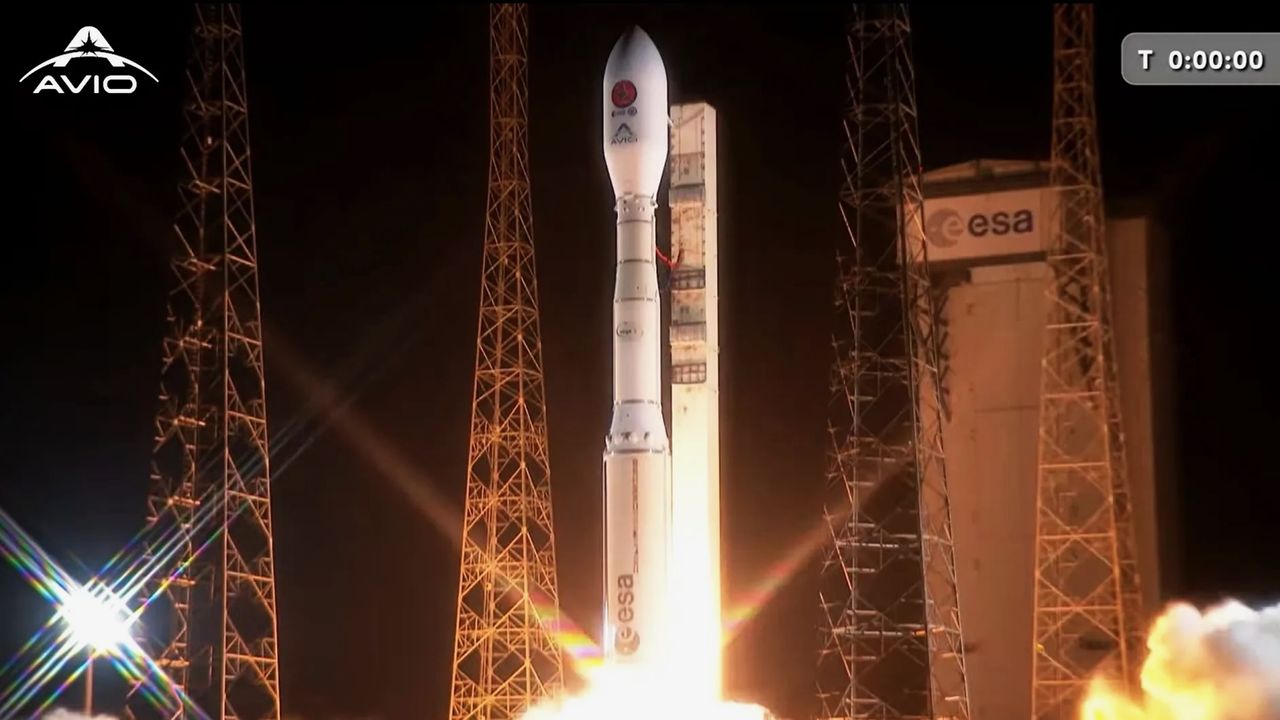
Europe and China successfully deployed their joint SMILE space weather satellite to orbit on May 18, using an Arianespace Vega C rocket. The mission lifted off from Europe's spaceport in French Guiana.
SMILE, which stands for Solar wind Magnetosphere Ionosphere Link Explorer, represents a collaborative effort between the European Space Agency and China's National Space Administration. The satellite carries instruments designed to observe how the solar wind interacts with Earth's magnetosphere, the protective magnetic field surrounding our planet.
The mission addresses a critical gap in space weather monitoring. SMILE will capture simultaneous observations of the magnetosphere's structure and dynamics from a vantage point about 150,000 kilometers from Earth, roughly halfway between our planet and the sun. This unique perspective allows scientists to track how charged particles from the sun compress and reshape Earth's magnetic field.
The satellite carries specialized instruments including soft X-ray imagers that detect energetic particles and magnetospheric interactions invisible to conventional telescopes. European researchers from multiple space agencies contributed to instrument development, while Chinese partners provided additional scientific expertise and payload components.
This launch marks a significant achievement for the Vega C rocket, which had experienced a setback in December 2022 when a structural failure caused a mission loss. The rocket subsequently underwent rigorous redesign and testing, with the May flight representing its successful return to service after the modifications.
Space weather monitoring serves practical applications beyond scientific curiosity. Intense solar storms can disrupt power grids, disable satellites, and interfere with communications infrastructure. Better understanding magnetospheric responses to solar wind conditions helps scientists predict space weather events and protect critical infrastructure on Earth.
The SMILE mission carries a nominal operational lifespan of three years, though extended operations are possible if the satellite remains healthy. Data collected will be shared between European and Chinese scientific teams, strengthening international collaboration in space science during an era of increasing