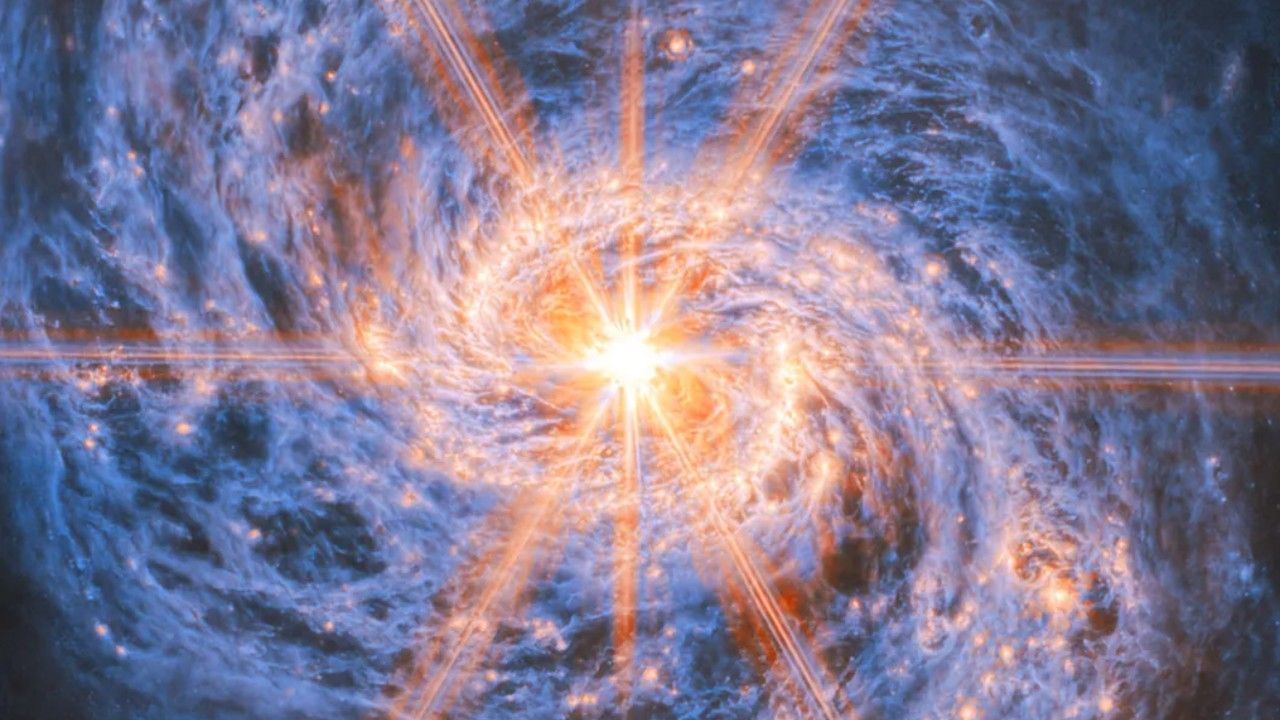
The James Webb Space Telescope captured a stunning new image of galaxy M77, revealing details of this distant spiral galaxy with unprecedented clarity. Located approximately 47 million light-years from Earth in the constellation Cetus, M77 appears as a luminous spiral structure with intricate dust lanes and bright star-forming regions visible across its disk.
M77, also known as Messier 77, ranks among the brightest known active galactic nuclei visible from Earth. The galaxy harbors a supermassive black hole at its center that actively accretes material, making it a valuable target for studying extreme physics and black hole behavior. Webb's infrared capabilities penetrate the thick dust surrounding M77's core, exposing features that visible-light telescopes cannot detect.
The new image showcases Webb's ability to resolve fine structure within distant galaxies. The telescope's Near-Infrared Camera and Mid-Infrared Instrument captured radiation from stars, dust, and ionized gas across multiple wavelengths. This multi-wavelength approach reveals the composition and temperature variations throughout M77's structure, providing astronomers with data about ongoing star formation and the environment immediately around the central black hole.
Webb observes in infrared wavelengths because dust absorbs visible light, scattering it away from Earth. By detecting longer infrared wavelengths, Webb sees through these cosmic dust clouds and reveals the hidden architecture of galaxies like M77. This capability represents a major advance over previous space observatories and ground-based telescopes.
The image demonstrates Webb's role in advancing extragalactic astronomy. Observations like this help astronomers understand how galaxies evolve, how supermassive black holes influence their host galaxies, and what conditions enable or suppress star formation in distant systems. M77 serves as a laboratory for studying these processes at work within an active galaxy visible across multiple light-years