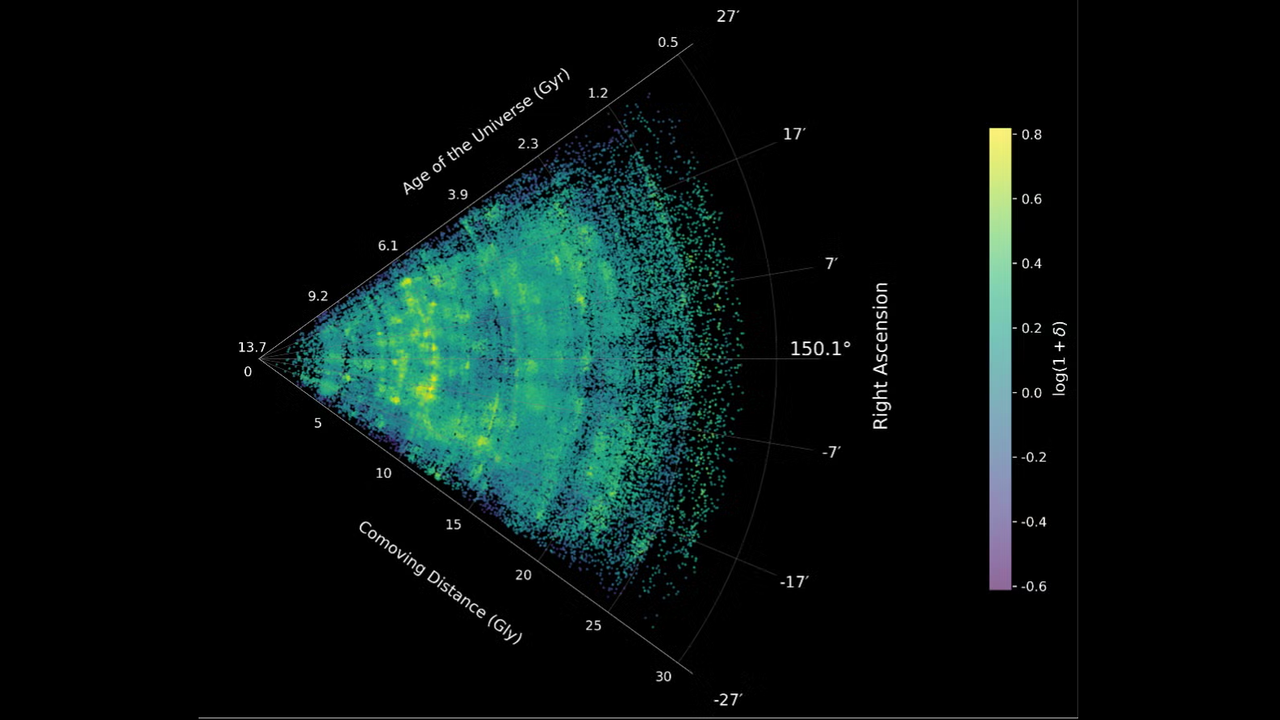
Astronomers using the James Webb Space Telescope have created the largest-ever map of the cosmic web, revealing the universe's hidden megastructures in unprecedented detail.
The cosmic web represents the large-scale filamentary structure of the universe, consisting of galaxies arranged along interconnected filaments with vast voids between them. This mapping effort leverages JWST's infrared capabilities to observe distant galaxies and trace the three-dimensional distribution of matter across billions of light-years.
Previous observations limited astronomers to smaller regions or less detailed views of this cosmic architecture. The new map captures a vastly larger volume of space with greater precision, enabling researchers to study how structures form and evolve across cosmic time. The infrared wavelengths that JWST observes allow astronomers to detect light from galaxies too distant or dust-obscured for visible-light telescopes to see clearly.
Understanding the cosmic web's structure addresses fundamental questions in cosmology. The distribution of matter reveals how dark matter, which comprises roughly 85 percent of the universe's matter content, organizes itself. It also constrains models of cosmic expansion, the role of dark energy, and how gravity has shaped the universe since the Big Bang.
The mapping technique likely involves spectroscopic observations or deep imaging surveys that identify galaxy positions and distances, then constructing three-dimensional models of their spatial arrangement. JWST's sensitivity allows researchers to probe regions previously inaccessible, revealing connections between galaxy clusters and the filaments linking them.
This work demonstrates JWST's capacity for large-scale cosmological surveys complementing its celebrated discoveries of early galaxies and exoplanet atmospheres. The detailed cosmic web map provides essential data for testing theoretical models of structure formation and refining our understanding of gravitational dynamics on the largest observable scales.
The research establishes a new baseline for cosmic structure mapping and will guide future observations as astronomers continue