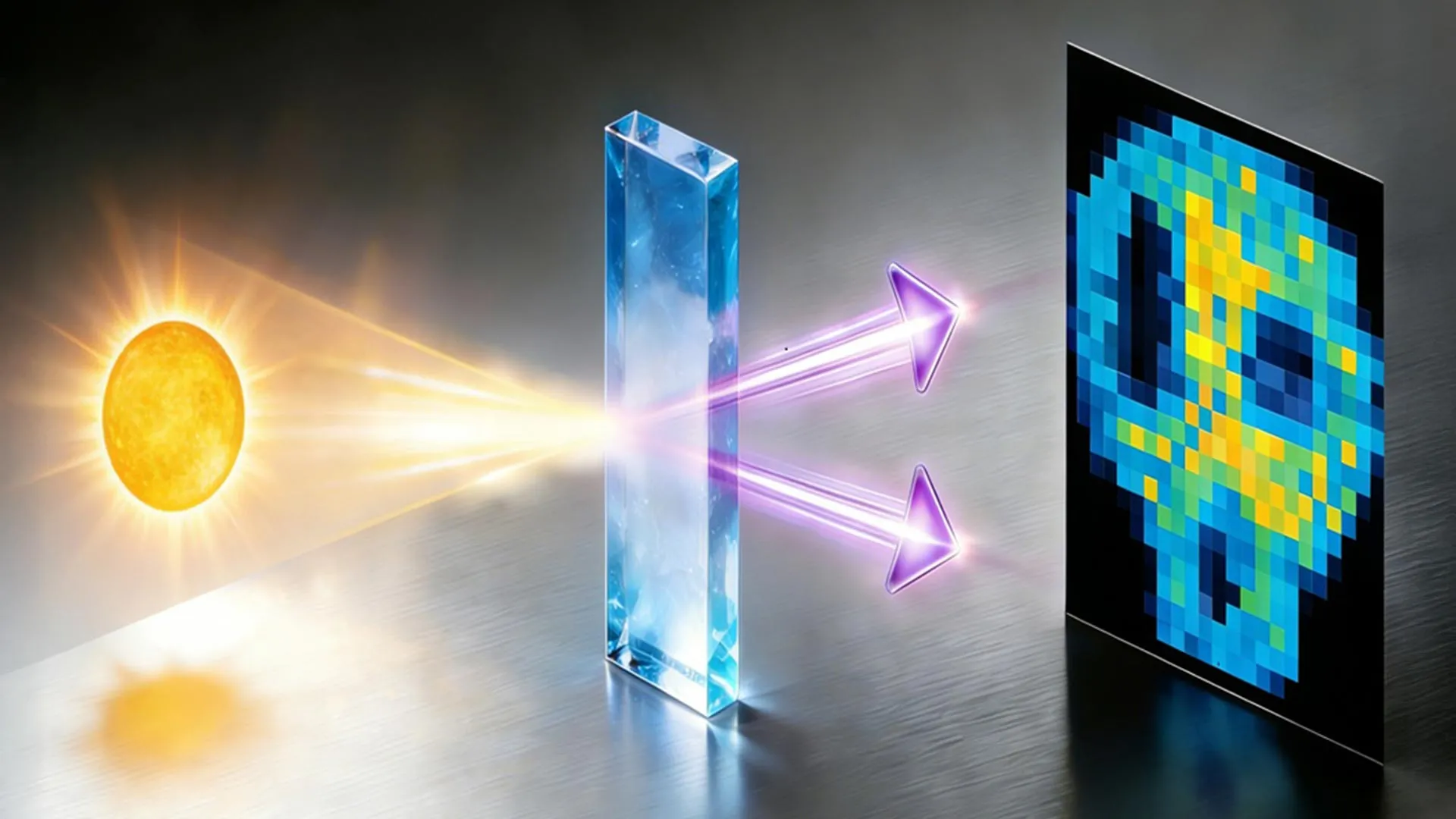
Researchers have demonstrated quantum ghost imaging using sunlight instead of laboratory lasers, challenging assumptions about what quantum technologies require. The team built a sun-tracking system that concentrates natural sunlight through optical fiber into a nonlinear crystal, generating entangled photon pairs with strong quantum correlations.
Ghost imaging reconstructs pictures indirectly by exploiting quantum links between photons rather than direct observation. One photon hits an object while its entangled partner bypasses it entirely. By correlating measurements from both paths, researchers recover image information without the object ever directly interacting with a detector. This counterintuitive approach normally demands precisely tuned laboratory lasers.
The sunlight-powered apparatus produced image quality approaching traditional laser systems. The team successfully recreated detailed images, including a face pattern, demonstrating that quantum effects persist despite the roughness and incoherence of natural sunlight. The critical innovation involved filtering and concentrating sunlight efficiently enough to generate measurable quantum correlations in the crystal.
This work expands quantum imaging beyond controlled laboratory settings toward practical, outdoor-capable systems. Sunlight is free, abundant, and available globally, removing a major barrier to scaling quantum technologies. Previous quantum imaging schemes required expensive, precisely maintained lasers and specialized facilities.
The researchers did not release detailed specifications in the available information, though the demonstration proves the concept works. Limitations likely include weather dependence, seasonal variation in sunlight intensity, and reduced photon pair generation rates compared to optimized lab lasers. The current system required active sun-tracking, adding mechanical complexity.
The findings open pathways toward deployable quantum sensing and imaging systems for applications like remote sensing or security screening. Sunlight-based quantum technologies could eventually become practical alternatives where laser systems prove impractical. This bridges fundamental quantum physics with engineering feasibility, demonstrating that nature's most abundant energy source can power delicate quantum phenomena.
CATEGORY