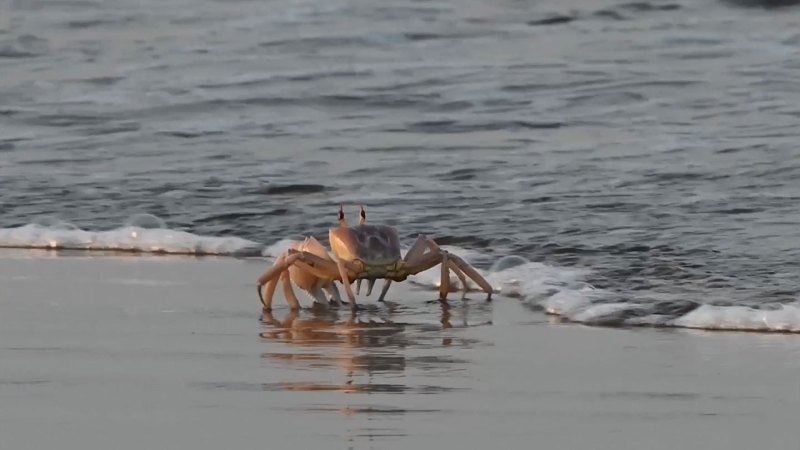
Researchers in Japan analyzed locomotion patterns across 50 crab species and found that sideways walking evolved only once, in a common ancestor shared by all modern crabs. This discovery suggests that the iconic movement became a foundation for the group's evolutionary success and diversification.
The study, published recently, reconstructed the evolutionary history of crab locomotion using comparative anatomy and phylogenetic analysis. Scientists traced the sideways gait back to a single origin point rather than multiple independent evolutions of the trait across different crab lineages. This monophyletic origin means all crabs today inherited the behavior from one ancestor that first adopted this unusual walking style.
Sideways locomotion gives crabs distinct advantages in their ecological niches. The perpendicular body orientation allows them to navigate rocky shores and seabeds efficiently, squeeze into tight spaces, and move quickly across sand or mud. These benefits apparently proved so successful that the trait persisted and became refined over millions of years of diversification.
The research illustrates how a single anatomical innovation can catalyze major adaptive radiation in a lineage. The 50 Japanese crab species examined represent different body sizes, habitats, and feeding strategies, yet all retained the ancestral sideways walk while evolving other specialized features. Some species developed powerful claws for crushing shells, others refined their antennae for detecting prey, and still others adapted to extreme depths or temperature ranges. The sideways gait remained constant across these variations.
This work provides a model for understanding how key evolutionary innovations propagate through animal groups. Rather than similar solutions evolving repeatedly when facing similar challenges, crabs apparently inherited a solution so effective that they never abandoned it. The trait became locked into their body plan, constraining how their limbs could evolve while still allowing dramatic diversity in other morphological features.
The findings underscore why crab body plans appear so standardized despite their ecological diversity.