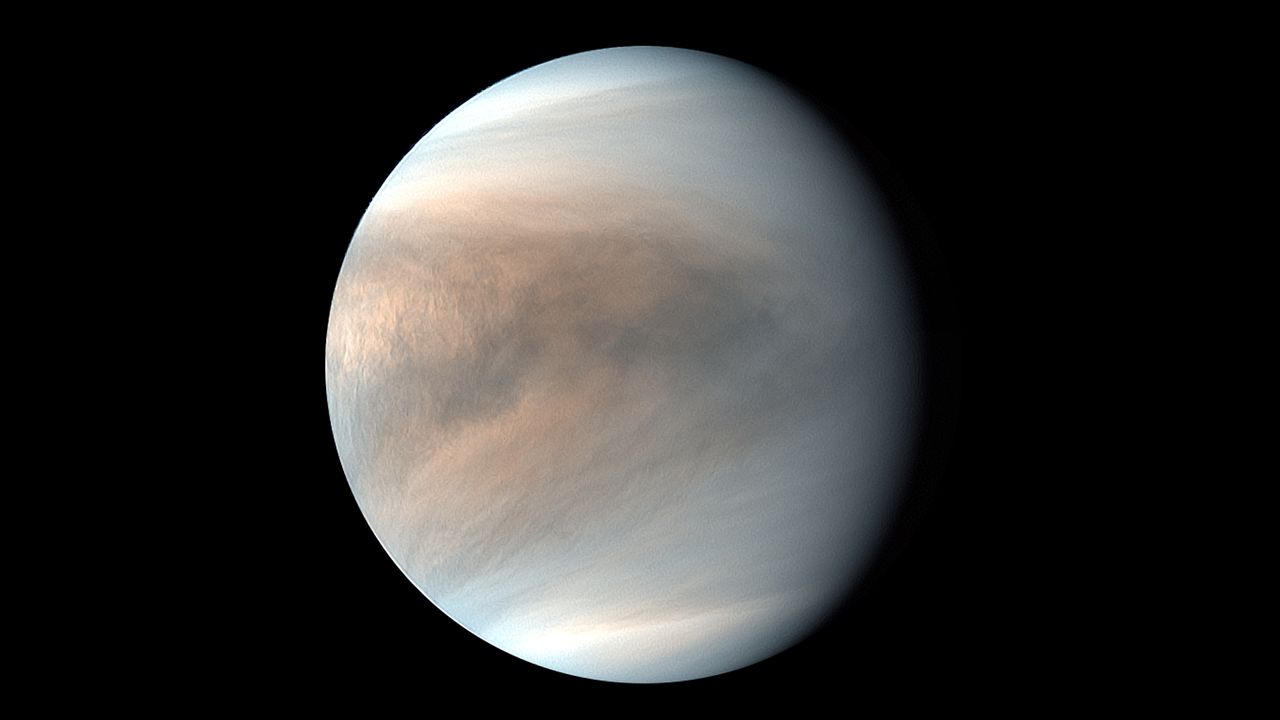
Researchers have identified a colossal hydraulic jump in Venus's atmosphere, a phenomenon more commonly observed in kitchen sinks, creating the planet's vast 3,700-mile-long cloud formation at altitudes exceeding 30 miles above the surface.
A hydraulic jump occurs when fast-moving fluid suddenly encounters resistance and spreads outward abruptly. On Earth, this happens at everyday scales when water flows from a faucet and hits the sink basin. On Venus, the same physics operates at planetary dimensions.
The cloud bank forms as wind patterns on Venus interact with the planet's rotation and topography. Fast-moving atmospheric flows slam against resistance zones in Venus's upper atmosphere, creating the characteristic spreading pattern of a hydraulic jump. The clouds consist primarily of sulfuric acid droplets suspended in the dense Venusian atmosphere.
This discovery represents the largest hydraulic jump phenomenon documented anywhere in the solar system. The sheer scale reflects Venus's extreme conditions. Atmospheric pressure at the surface reaches ninety times Earth's sea-level pressure, and temperatures exceed 900 degrees Fahrenheit. Even at the cooler altitudes where these clouds exist, conditions remain harsh enough to dissolve most spacecraft components over time.
Scientists made this connection by analyzing atmospheric dynamics models and observational data from Venus. The hydraulic jump mechanism helps explain why this particular cloud formation persists and maintains its distinctive structure despite Venus's chaotic atmospheric circulation patterns.
Understanding Venus's cloud dynamics contributes to broader knowledge of planetary atmospheres across the solar system. Venus offers insights into how extreme atmospheric conditions shape weather patterns at scales impossible to replicate on Earth. The planet's runaway greenhouse effect and dense atmosphere make it a natural laboratory for studying extreme atmospheric physics.
Future Venus missions, including planned orbital and atmospheric probe missions from international space agencies, will gather more detailed data on these cloud structures. Improved observations could reveal how often such hydraulic